Tuesday, September 8, 2009

When burlap sacks save the world

When our world ends — like really ends — let’s pray that little burlap dolls aren’t left to fix our mistakes. Although, at that point it's unlikely anyone will be around to do any praying. Hell, at that point dolls or even rusty carburetors could be tasked with the cleanup and either way mankind wouldn't peep a single complaint.

I watched 9 keenly, absorbed by its post-apocalyptic detail and its well-choreographed action, but for the life of me I couldn’t tell you why six-inch-tall ragdolls were given the job of saving the world. Or why a scientist, who could inject his soul into anything, would choose forms so tiny and so incapable of preserving man’s dual legacy of hope and destruction. I question this part of the plot, but let that be my only complaint on this strikingly different animated film.


In 9, it’s the not-too-distant future and scientists have created artificial intelligence, which will be invented to be villains in movies like this or the Terminator franchise. Notice the “peacekeeping” machines that first roll off the assembly line: they all have chaingun turrets to, you know, keep the peace. Of course, the AI responds to man’s control with hostile force and eventually every city on the planet is a smoking crater of poison gas and brimming with the stench of death.


Living in the smoldering remnants of man are the nine little stitched dolls, each named in the order that they were made. 9 is the last one created and he awakes in confusion: what is his purpose, he wonders, as he claws through the detritus of splintered wood, powdered brick and decaying bodies. This movie is not shy with its treatment of death, and it rightfully earns its PG-13 rating; think twice before bringing little ones.

Eventually 9 (Elijah Wood) meets up with the other eight sack people, including fear-mongering leader 1 (Christopher Plummer), gadget guru 5 (John C. Reilly), sexy fighter 7 (Jennifer Connelly) and loony tune 6 (Crispin Glover). Their purpose in this apocalyptic landscape, they reason, is to hide from the last of the nomadic machines as it scours the cracks for things to kill.


Surely life has more purpose, free-spirited rebel 2 (Martin Landau) says. He’s proven right after 9 finds a thimble-like artifact that accidentally turns the machines of war back on after their battery life expired long ago. Before they could hide in fear, but with fresh smoke billowing from the factories of death, the nine now have to fight or be crushed in a second apocalypse. The movie never establishes the nine’s importance well enough that we can accept their role in ending this world-obliterating calamity, but the nine believe it and that counts for something.

I love the style and feel of this film. The sack people, with their zippered fronts and hand-stitched joints — apparently this is called “stitch punk” — are terrific, albeit outlandish, subjects. They have these can-like eyes with snapping little apertures for eyelids that allow for full, expressive emotions. The villains they fight, assembled from the rubble of the wasteland, are equally impressive as harpoon-tailed pterodactyls, wormy snakes that can cocoon victims in scarlet thread, and a robotic cat with a real cat skull for its head. The bombed-out landscape provides many opportunities for these two sides to battle, and battle they do on the crashed wing of a bomber, on the plains of the war-ravaged countryside, and on the mechanical arms of a brain machine.

Mostly I liked this film because it was completely original. When was the last time an animated film used the post-apocalypse as a setting? Or featured death in such a challenging way? Or had non-human characters that weren’t talking animals? You can answer all three questions with “never” or “almost never.”


Like Coraline before it from earlier this year, 9 presents a frightening story and tells it in an inventive, unforgiving way. Children need not be coddled so diligently in this day and age. If they can handle it, let them be a little scared with 9 and its unique burlap heroes.

And just because I love the 9 artwork, here's more:

Friday, September 4, 2009

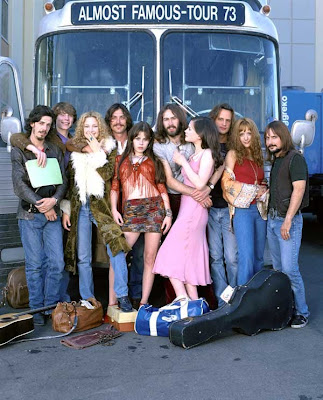
Almost Perfection: Crowe creates a classic

This is the second in a series of essays about great films from the first decade of the 21st Century. I'll pick a new movie each week leading right up to my final list in December 2009.

Almost Famous is one the most pure collections of cinematic moments of the last decade. Its poetry is expertly directed, marvelously written and carefully acted out by performers who will strive for the rest of their careers to find better roles only to come up short every time.

The fact that it’s partially autobiographical for writer and director Cameron Crowe makes it somehow even more poetic: this story actually happened in some form, and it’s not just the whimsy of some distant Bach-loving writer.


Crowe, who gave us Fast Times at Ridgemont High and Say Anything, was only a teen when he traveled with the Allman Brothers and other rock greats as a writer for Rolling Stone magazine. He witnessed turmoil, success, groupies and drugs from the sheltered perspective of a rock journalist. He grew up, married a rock star (Nancy Wilson of Heart), wrote some film scripts and then directed a few; everything seemed to be building up to Almost Famous, Crowe’s very personal magnum opus. When he finally undertook the film, in that glorious year before 9/11, he was ready. He brought an authenticity to the film and the innocence of that teen-version of himself. No one else could have done it with this passion and insight.

The film follows 15-year-old William Miller (Patrick Fugit), whose dream to become a rock journalist is given some legs when Rolling Stone magazine, thinking he’s an adult, gives him an assignment: 1,000 words on Stillwater, America’s newest up-and-coming rock band. The film takes place in 1973, when great music is still emerging from the ’60s for rock’s “death rattle, its last gasp.”


Early in the film William meets Creem magazine writer Lester Bangs (Philip Seymour Hoffman), who extols some insightful wisdom to his young apprentice: do not make friends with the rock stars (“Friendship is the booze they feed you”), beware of the “swill merchants” at Rolling Stone, and don’t write sanctimonious stories about the genius of the rock stars (“They will ruin rock ’n’ roll and strangle everything we love about it”). Crowe might have been quoting the real Lester Bangs’ work, or he might have been offering his own editorial of the current state of rock. In any case, the film acknowledges in every note that the post-Woodstock pre-disco era was the golden age of rock ’n’ roll and Almost Famous captures all of its electric energy to the point that we sadly grieve its passing from the screen's edges.

Although music is this film’s lifeblood (more on that later), what really gives it its soul are warm, compassionate performances by Fugit, the floppy-haired “enemy” to the rock band; Billy Crudup, who plays Stillwater’s enigmatic guitarist Russell Hammond; Frances McDormand, who plays William’s paranoid mother; and, most famously, Kate Hudson as the beautiful Penny Lane, Stillwater’s resident groupie or “Band Aid.” Band Aids, we're told, inspire the musicians with their beauty and finesse, and never with sex — "Just blowjobs and that's it," one Band Aid says very matter-of-factly.

When the film was released in 2000, Hudson was an unknown. Almost Famous is what delivered the young actress, daughter of Goldie Hawn, to the masses and launched her entire career. Her Penny Lane is magical, the kind of character we fall in love with — a Grace Kelly performance. You simply can’t take your eyes off her. It’s a big, brave performance with a number of important scenes, including a Quaalude overdose, but watch the little scenes: Hudson shooing off other girls from the Stillwater guitarist in a crowded hallway, ironing clothes during a band fight, dancing on concert trash in an empty venue, her tears when she finds out she was traded to another band for a case of beer. It’s a total performance, and Hudson never stops acting or dials it down. At one point the film frames her eyes in a close-up that it has to be one of cinema’s most beautiful single frames ever photographed. We know what groupies will do for rock stars (anything), and I fear another actress would have made Penny Lane too sexual, whorish even, but Hudson gives the character dignity, morals and confidence, yet retains that sexual liberation and expression.

Hudson is absolute perfection, but so are many roles in this marvelous film. I love Jason Lee’s performance as Jeff Bebe, Stillwater’s Robert Plantish lead singer. “I work just as hard or harder than anybody on that stage,” he screams at the guitarist during a band meeting. “You know what I do? I connect. I get people off. I look for the guy who isn’t getting off, and I make him get off.” Or consider Zooey Deschanel — Zooey, glorious, Zooey — as William’s sister who has to sneak her Simon & Garfunkel albums into the house and later provides some good advice: “Listen to The Who with a candle burning and you will see your entire future.” And then McDormand as William’s mother, who believes “adolescence is a marketing tool.” She is one of the many poets of the film, and her warm compassion seems to counter-balance the icy distraction of William’s rock world. She has one of the bigger jokes of the film: outside a concert venue she instructs her son from the family station wagon, "Don't do drugs!" All the concertgoers, some plucking joints from their lips, turn and recite it back in a rowdy chorus, "Don't do drugs!"

The film casts these honestly written characters, and many others — including more Band Aids played by Fairuza Balk and Anna Paquin — in the film’s cross-country journey of concerts, after-parties and tumultuous band meetings in which the only thread holding Stillwater together is seemingly William, the writer who might get the band on the cover of “Rolling Stone fucking magazine.” All along the way he parties a little, falls in love with Penny and interviews the band members with the exception of Russell, who delays and delays until William has missed his high school graduation and driven his mother into a panic (“Rock stars have kidnapped my son,” she tells a classroom of college students). The film builds and builds until finally the tour is over, the Rolling Stone piece is done and the Band Aids have to disperse before the real girlfriends show up. And William returns home to collapse on his bed in defeat after Rolling Stone’s fact checker says the band denied 90 percent of William’s story. There’s more to it that I'm leaving out, of course, but I love the ending. It feels complete in every way.

I said I would get back to the music and here it is: music is 50 percent of the greatness of this film. Crowe, ever the music fan, knows how to pick appropriate tunes for his characters and scenes. If you’re like me you’ll see scenes of the movie when you hear these songs outside the context of the film: greats like Simon & Garfunkel’s “America,” Elton John’s “Mona Lisas and Mad Hatters,” a number of Led Zeppelin songs including “Tangerine” and “Misty Mountain Hop,” and Cat Stevens’ “The Wind,” which is featured in the lovely scene of Penny Lane dancing on the concert trash. Even Stillwater, the film’s fictional band, has some wonderful era-appropriate music that they play during many of Almost Famous’ concerts. The music ascends past greatness in one scene in particular, a scene that has come to symbolize the power that music and film hold over us: Stillwater, on the verge of a split, rides through Kansas on the tour bus and slowly, one by one, the band joins in on singing Elton John’s “Tiny Dancer.” It’s an act of forgiveness and the music wipes the slate clean. It’s a moving, powerful scene and it represents the height of Crowe’s skills.

I must acknowledge here that Almost Famous is a very personal film to me. It hit me at a turning point in my life. I had just graduated high school, just started doing rock journalism (and movie reviews) and found myself in many William Miller-like band situations. Almost Famous is truth. It shows a teen with hopes and dreams. All too often teens are written into movies simply to exist in classrooms or at dinner tables with grown-ups. Here’s a film where the kid is as much of the story as any of the adults, and his desires, dreams and fears are given the weight they deserve. Almost Famous is not a perfect movie — few movies are — but it feels like one, especially when you consider your emotions when the film ends. If you're like me, you're floating on a cloud.

Monday, August 24, 2009

Tarantino, that glourious basterd!

World War II has been covered so extensively on film by so many gifted directors — and some hacks — that any true originality in the genre was mined long ago. Quentin Tarantino found a way around all the worn plots with this audacious strategy in his intentionally misspelled Inglourious Basterds: he wrote his own version of the war.

That’s right, he just made stuff up. That should be sacrilege to history, especially since WWII is hallowed ground even 60-plus years after its end. But Tarantino gets away with it — he gets away with everything — because his film provides a catharsis that the war itself could not provide. In his version of events, the war ends after a rag-tag group of Jewish Americans stage a mass execution of German high command in a little French movie theater. Film buffs should have fun with that movie theater part. Only Tarantino, a noted film buff, could stage a gunfight in a projection booth. Only Tarantino could kill Hitler with in an inferno fueled by nitrate film stock. Only Tarantino would have a movie critic parachute into Nazi-occupied Europe to help end the war.

Full of likeable every-guy heroes, menacing German villains, seductive femme fatales, fully-dressed locations and sets, exquisite costumes of square-shouldered Gestapo overcoats and tatty American tank tops and fatigues, and a variety of languages (German, French, Italian, English), Inglourious Basterds is, for the most part, your run-of-the-mill World War II movie. But Tarantino filters the story through his movie-loving brain to produce this mish-mash of cocaine-induced hyper-stylized film homages. The title may refer to its heroes, a troop of vigilante soldiers who have no higher command to answer to, but it also refers to the bastardization of other film genres to tell its story.


It’s been widely reported that Tarantino wanted to merge a classic war movie with an epic Spaghetti Western. At one point the film was going to be called Once Upon a Time in Nazi-Occupied France, an allusion to the famous cowboy opera by Sergio Leone, an obvious influence here. Remarkably, almost inexplicably, QT accomplishes this Frankenstein-like assembly and then gives it the juice it needs to stomp through Kraut-occupied France in one of the most daring films of the year. Daring because you must adopt a new WWII history and also because impatient Tarantino fans will likely be challenged as the dialogue proves to be painstakingly, yet pleasantly, prosperous and the violence is shortlived, albeit quite gory when it does finally turn up in a head-smashing homerun derby.

The first scene could easily be right from a Leone film: a French farmer hosts an unannounced SS officer during his search for Jews in the countryside. They talk slowly, carefully. The Nazi is given milk. They smoke from pipes. The tension builds. They’re playing chess with their dialogue. A couple minutes stretches into a dozen. The officer is smart. The farmer is trapped. By the time the Nazi asks, “Are you hiding Jews in this house?” the man has tears streaming down his face. Like Leone, Tarantino allows dialogue to serve as suspense.


Not all of the dialogue is as flowery, though. Consider Aldo Raine (Brad Pitt), the leader of the Basterds, a group of American troopers sent into France to scalp Nazis first and ask questions … well, never. Raine talks like he learned English from a drill instructor: “You probably heard we ain’t in the prisoner-takin’ business. We in the killin’ Nazi business. And cousin, business is a-boomin’.” Each word is nearly grunted, but he grunts to an unheard rhythm, and Pitt grins from behind the character, a stone-cold killer reduced to lovable miscreant if only because history has allowed us to hate Nazis as much as him.

Raine’s patrol includes a bat-wielding slugger nicknamed the Bear Jew, and German defector Hugo Stiglitz, who’s introduced in a Blaxploitation style so bold his name should include exclamation marks. The Basterds roam the countryside, tallying up notches on the butts of their Garands, Thompsons and, in the case of the Bear Jew, his bloody Louisville Slugger. A British general eventually concocts a plan to assassinate a number of high-value German officials — we know their names: Goebbels, Bormann, Hitler — as they debut a new propaganda film showing the Third Reich flourishing.
The movie, of course, is some kind of Leni Riefenstahl parody involving a German sharpshooter who single-handedly kills upwards of 300 GIs.

I will let you discover where it goes from there, and trust me when I say that Tarantino will not hesitate doing anything. His movies are exciting in that way: they can go in any direction, and they’re bound by no formula. Tarantino movies are also hilarious, and this one is no exception. I will say that there are some wonderful performances by Diane Kruger, as a German double agent Bridget von Hammersmark, and French actress Mélanie Laurent, who has a wonderful scene set to the anachronistic music of David Bowie’s “Cat People.”

German actor Christopher Waltz should be a shoe-in for an acting nomination this year for his role as Col. Hans Landa, the officer from the first scene and many others like it. His dialogue is prepared so meticulously, with reverence to the needs of the movie and of the character, yet he explodes from the pressed Nazi uniform. He’s one of the most demented characters created this year, and somehow also one of the most electric and captivating.

Pipe-smoking Landa, the Basterds, the exploding cinema … the imagery, almost iconic in stature, will likely remind people of Sam Fuller’s The Big Red One, another original WWII film. In one of the more perversely metaphorical scenes from that film, a woman gives birth inside a bombed-out tank, bullet belts serving as stirrups. Basterds attempts another coup on the genre with potent images, punchy dialogue and this punk energy that only Tarantino can produce.


Inglourious Basterds is the most originally entertaining film of the year, and it earns it with every scene.

Friday, August 14, 2009

"What came first: the music or the misery?"

This is the first in a series of essays about great films from the first decade of the 21st Century. I'll pick a new movie each week leading right up to my final list in December 2009.

High Fidelity
is a brutal examination on men’s various failures, namely in one department — women. The fact that it speaks so eloquently to both sexes, though, is one of its strongest points.

It’s shot as one man’s testimonial to his own shortcomings. He speaks to us right from the screen in a way that’s so conversational we’d respond back if listening weren’t so enjoyable. He begins the film pointing blame and he ends it accepting responsibility. Between the two points we can plot how he learns of, and course-corrects, his many deficiencies, and how he slowly backs away from the vast precipice that leads to the loneliness of middle age.

The man in the film is Rob Gordon, a hopeless neurotic covered in flannel and corduroy played by the only man capable of making him real, John Cusack, who is so instantly likeable that we cringe a little when we find out he cheated on his girlfriend when she was pregnant and that his affair directly led to her getting an abortion. “You fucking asshole!” his sister screams at him while we sadly nod in agreement. But Rob’s not all bad, and we spend much of the early part of the film getting to know him and his path through life, which plays like a worn spot on a piece of carpet.

Rob owns a record store, Championship Vinyl, in a tucked-away corner of Chicago where foot traffic is at a minimum. In one of many breaking-the-fourth-wall moments, Rob tells us: “I get by because of the people who make a special effort to shop here — mostly young men — who spend all their time looking for deleted Smiths singles and original, not re-released, Frank Zappa albums. Fetish properties are not unlike porn. I’d feel guilty taking their money, if I wasn’t … well … kinda one of them.” He employs two record store snobs, Dick and Berry, who dissect customers’ musical tastes like parade commentators, but with the viciousness of wolves. When business is slow they create hypothetical Top 5 lists of things like Best Track-One Songs or Great Songs About Death, to which Barry (Jack Black) opines about “Wreck of the Edmund Fitzgerald” by Gordon Lightfoot and “Leader of the Pack” (“The guy beefs it on his motorcycle”).

The Top 5 motif is the theme for the film as Rob takes us through his Top 5 All-Time Breakups after his girlfriend of several years, Laura, leaves him in the first scene. Maybe to make her mad, or just to dilute the love he truly feels for her, Rob leaves Laura off the list: “There’s just no room for you in the top five. Sorry, those places are reserved for the kind of humiliation and heartbreak you’re just not capable of delivering.” Slowly, across the framework of the rest of the film, Rob narrates the five breakups. First there was the six-hour relationship with Allison in junior high, followed by virginal Penny in high school. Extrovert Charlie (Catherine Zeta-Jones) was in college, and that breakup wrecked Rob — “Some people never got over Vietnam or the night their band opened for Nirvana. I guess I never got over Charlie.” Then there was Sarah, whose self-medication included lonely, broken men.

Your math is correct and that’s only four women; the fifth is eventually deleted to make room for Laura, who Rob determines he will never forgive and then in the same breath admits he loves for eternity. Rob can be every man in the world with his post-breakup flaws — the hurt, the regret, the selfish anger, the reckless stalking, the obsessive analysis and deep introspection — and yet he can also be completely unique in this intelligently penned script, based on a Nick Hornby novel of the same name but originally set in Britain.

I’ve talked a lot about Rob, but Laura is a key factor here, even if she’s put on a pedestal for Rob and his audience to admire and pick apart. Actress Iben Hjejle plays her to absolute perfection. In her subtle and underplayed performance you can see what Rob fell in love with, and you can see why she feels beyond him and his adolescent, emo-tinged moping. Laura’s choices — the tantric-schooled pony-tailed Ian (Tim Robbins), the abortion, the inevitable forgiveness of Rob’s quirks — are not merely plot points for the film to slalom through during a race to the finish, but real events with real consequences. These are authentic people, dominated by realistic dreams and goals that you and I and 98 percent of the country has. Life is pulsing from these characters.

In fact, life’s pulsing from the whole movie. It all feels alive, every frame, which is nice since it’s all shot in Chicago, a city pulsing with eclectic energy. Not since John Hughes, or maybe The Dark Knight, has the city been given a kiss this sloppy-wet. And if there’s another non-human character to acknowledge it has to be the music, which is embedded in the DNA of High Fidelity. The film opens with a great first line and monologue: “What came first: the music or the misery? People worry about kids playing with guns, or watching violent videos, as if some sort of culture of violence will take them over. Nobody worries about kids listening to thousands — literally thousands — of songs about heartbreak, rejection, pain, misery and loss. Did I listen to pop music because I was miserable? Or was I miserable because I listened to pop music?”

The music provides not only the backdrop for Rob’s self-inflicted suffering, but the setting that's cascading out from behind Championship Vinyl, where Dick and Barry agonize over Green Day comparisons and Beta Band EPs, where Barry decides to start a band called Sonic Death Monkey, where Rob offers to make someone a mix tape and then realizes that mix tapes are so sacred they’re like a notch or two below actual sex, equal to at least foreplay. At every step, music is pulsing from either the soundtrack or the character’s thoughts. At one point Bruce Springsteen, half-heartedly plucking at a guitar, turns up in a dream, and it hardly seems surprising. This film is in love with music and, best of all, it understands music, especially good music.

Few movies have answers for everything, yet I think High Fidelity gets pretty damn close. From every crevice wisdom spills onto the screen, creating a tapestry of bizarre life lessons. Like, for example, how do you make a mix tape? “First of all, you’re using someone else’s poetry to express how you feel; this is a delicate thing.” Can Peter Frampton ever sound amazing? The movie says yes, when sung by a woman, or just Marie De Salle (“Is that … Peter. Fucking. Frampton?”). And I’m convinced the meaning of the universe can be deciphered in the sentence, “I haven’t seen Evil Dead II yet.” Oh and there’s more:

• Rob describes how he tried to round second base with his make-out partner, failed, then tried to steal third out of desperation: “It was like trying to borrow a dollar, getting turned down and asking for 50 grand instead.”
• Describing a one-night-stand: “She’s kinda Sheryl Crowish crossed with a post-Partridge Family, pre-LA Law Susan Dey kinda thing, but you know … uh, black.”
• Rob on lonely people: “I could’ve wound up having sex back there. And what better way to exorcise rejection demons than to screw the person who rejected you, right? But you wouldn’t be sleeping with a person; you’d be sleeping with the whole sad, single-person culture. It’d be like sleeping with Talia Shire in Rocky if you weren’t Rocky.”
• Rob on bravery: “Should I bolt every time I get that feeling in my gut when I meet someone new? Well, I’ve been listening to my gut since I was 14 years old, and frankly speaking, I’ve come to the conclusion that my guts have shit for brains.”

Not since The Godfather has a movie been so instantly quotable.

High Fidelity is such a potent break-up movie that it will throw salt in all the wounds left by those you’ve loved and lost. If your thoughts don’t wander to your most recent breakup then I implore you to turn the film off until you find that state of mind. I’ve seen it many times and my mind always drifts back to one girl. When things were perfect they were perfect. Then it all fell apart. Hindsight being what it is I can see now that it would have never worked out — we were all wrong for each other from the very beginning. But the love is still there (even though she’s with an Ian). And if Rob teaches us anything, it’s this: Some relationships are born perfect, some just hold that form in our minds. Sometimes this movie is a laugh-out-loud riot, and other times it can be brutally, agonizingly poignant, the kind of movie you wrestle through because you see yourself or people you know in Rob’s shoes.

The movie also suggests that most women fall into five personality types: Allisons, Pennys, Charlies, Sarahs and Lauras. And most men are Dicks, Barrys, Ians or Robs. They represent each of us, and all of us at the same time. For a movie to define not only itself, but everyone else, is a rare thing indeed.

Thursday, July 30, 2009

Drawn and quartered: Sandler bares his soul

Funny People has confirmed something that I’ve known for a very long time: Adam Sandler is marginally proud of his bird-brained, baby-voiced comedies like Billy Madison, but please don’t carve their titles onto his headstone when he dies.

Life needs more substance, he comes to learn, and substance can’t be found in silly voices and situational comedies where he adopts a kid to make picking up women easier (Big Daddy) or that one with a magic remote control that could mute out his nagging wife (Click). And, apparently, beating people senseless was counterproductive on some sort of metaphysical level.


Say what you will about Adam Sandler — and I’ve said a lot of mean, hateful things (all justified) in reviews over the years — but he bares his soul in Funny People, a movie that could easily be his life story, or swan song. In fact, the film opens with real home videos of a teenage Adam Sandler prank calling restaurants and wandering around New York City. This is pre-SNL Sandler, and he has this sparkle in his eye as he tells a restaurant manager in an elderly woman's voice that "the roast beef is really good, but it makes me go to the bathroom every time." Of course, Sandler grows up to become a megastar, which is basically the route Funny People follows. Where Sandler ends and George Simmons, the character he plays, begins is a seamless, fluid transition that is almost imperceptible. It’s a testament to Sandler’s abilities, of which he has many (Punch-Drunk Love, Reign Over Me) when he’s not chasing invisible penguins or, and I quote, “shlibby-dibby-doo gally-hoo-hoo.”

Simmons is a Hollywood comedy star whose films could easily be real Sandler vehicles, including one where he plays a man transformed into a baby with a giant adult head, and another where he plays the bumbling oceanic superhero Merman. These blockbuster films have alienated him from real comedy, especially from his roots, stand-up, where people much funnier and much more talented than him stare up at his mega-grossing comedy with bitterness and resentment — call it the Dane Cook Syndrome. Or maybe the model was really Eddie Murphy, who started raw and ended up doing kiddie comedies with talking animals and day care children.

Anyway, a funny thing happens: George gets an incurable form of blood disease. Suddenly his reign on top — alone with no wife, no children and no real happiness — doesn’t feel so glorious. In a bid to recommit himself to life, what little of it he has left, he hits the comedy circuit, calls his ex-girlfriend to apologize and begins eBaying all his unopened Hollywood freebies. Helping him through all this is Ira (Seth Rogen), an amateur comic George meets at a Los Angeles comedy club. Ira, seeing an opportunity to write for a legitimate star, jumps aboard not realizing the implications caused by George's celebrity personality
.

The film’s highest priority is the salvation of George’s broken and barren soul, but the buddy-buddy relationship between Ira and George comes in a close second. They’re both commiserating Jewish comics, both playful wordsmiths and both are hopeless when it comes to women, although George is fairly good with the one-night-stands, including one who asks for the Merman call during the big show. The two comics share one key difference, though: Ira’s comedy is organically funny and George's is forced and synthetic coming from a man who no longer experiences life from the perspective of a normal person. It goes back to an old saying: Never trust a comic who arrives to the show in a limousine.

In these types of films — call them Illness Movies — it’s typical to see the dying person change for the better. Funny People abandons many of the clichés, including that one: George is still a self-centered jerk, still a pompous windbag, still a hack comedian with a bad catalog of pictures. He barks at Ira, orders him to fetch Diet Cokes, steals his potential sleeping partners and he pulls the celebrity card too frequently. But the film doesn’t apologize for his behavior. It simply exhibits it as a form of character study: Here's a man who's laughing on the outside and crying on the inside. And even that dynamic fails him in the end.


Funny People is largely about George and Ira (sadly, no Gershwin turns up), even though the rest of the cast could fill up three other comedy movies. Jonah Hill (Superbad) plays Ira’s tightly wound roommate, as does Jason Schwartzman, whose character is on one of those laugh-tracky high school sitcoms that real comedians groan at. The always-terrific Leslie Mann (Knocked Up and the director's wife) plays an ex-girlfriend who wants George back after discovering her husband (Eric Bana) is cheating on her in China, with massage therapists no less. Refreshing newcomer Aubrey Plaza plays Ira’s crush, an emotionless comedienne with a 10-day window. Oh, and the cameos, there’s plenty: Paul Reiser, Andy Dick, Norm McDonald, Eminem, Ray Romano, Sarah Silverman and Wu-Tang founder the RZA manning a deli counter.

As many people as there are, though, George is never outplayed or overwhelmed. He and Sandler are the stars, and the famous director, comedy juggernaut Judd Apatow, knows this and gives them ample time to share their stories. And as funny as it is, it’s also very mature and focused, even if there are more wiener jokes than at an Oscar Meyer stockholder’s meeting. In one scene Ira turns to James Taylor to ask if he ever gets tired of playing "Fire & Rain," to which Taylor responds to the comedian, "Well, do you ever get tired of talking about your dick?" Touche, Mr. Taylor, touche. The film is a little long at 150 minutes, but I liked that Apatow allowed his characters time to grow, or maybe just shrivel in George's case.

Funny People is a lonely, unapologetic look into a man’s deepest fears — being forgotten. Watching it you can see why funny people like Chris Farley, John Candy and John Belushi went through bouts of depression before self-medicating the solitude away. Sandler, it seems, has beaten that trend and Funny People is the proof.

Saturday, July 18, 2009

The end draws near for Potter and crew

As confusing as all the spells and magic formulas are in these Harry Potter flicks I doubt the children who flock to them in drooling packs will be as perplexed by the Horcrux spell or dragon’s blood potions as they’ll be by all the snogging in this, the sixth Potter film.

Yes, there’s lots of snogging in Half-Blood Prince, enough so that I can begin a review with it. Snogging is the cheeky British word for making out, although it sounds like it requires a cigarette afterward. Ginny Weasley snogs with Dean Thomas. Ron Weasley snogs with Lavender Brown. Hermione wishes to be snogging with Ron while Harry Potter longs to be snogging with Ginny, even as he makes tactical moves to snog with a cute waitress and then a batty Luna Lovegood. At one point Ron takes a love potion and nearly snogs nice and hard with Harry, who is clearly not so keen to snog back. And then there’s emo-king Severus Snape, who’s wound so tight he needs a good snog just to lighten up.


That’s a lot of names to hit you with so soon (and a lot of snogging, too), but by now some of those names have entered into the pop-culture lexicon and need no introduction. Han Solo, Fozzie Bear, Donald Duck, Vito Corleone, Harry Potter … some names just speak for themselves.

Aside from all the rump-slappin’ love that’s floating through the cast of characters, all the usual J.K. Rowling fantasy elements are present and accounted for: a train ride through the country to Hogwarts School of Witchcraft and Wizardry, Quidditch matches, paintings that come alive from the walls, Hagrid and his creepy pets, and a wacky new teacher, this time it’s Professor Slughorn (Jim Broadbent). Thankfully, one thing's not returrning — all the floppy homeless-looking
haircuts.

Harry Potter (Daniel Radcliffe), still reeling from the calamity of the last movie, Order of the Phoenix, is taking orders directly from an increasingly worrisome Professor Dumbledore (Michael Gambon). Voldemort and his many black-cloaked minions are still in an undeclared war with Dumbledore and Hogwarts. Many of Voldemort’s tactics are guerrilla incursions — espionage, abductions, random terrorizing, mischief. By the end of the film, war will be officially declared with a salvo that strikes at the heart of Hogwarts. I am, of course, referring to the spoiler — "______ kills ______" — those meanies (read: heroes) from the YouTube video yelled at the group of kids who had just purchased the minutes-old sixth book.

The plots, as fiendishly inventive as they are, have never really been the high points of Potter films; this one is a mystery (they all are) with Harry trying to mine the brain of Slughorn, who taught a young Voldemort at Hogwarts. What I admire over the plots are all the characters, and all the things that create the atmosphere of Potter’s world: the lavish sets, the hundreds of little magic props, those wonderful costumes and all the special effects, magic tricks of a different variety — movie magic. Many of the effects are disposable sights sprinkled into the film just because they’re so delightful, like one of a little penguin skiing in the icing on a cake.


Really, though, Harry Potter films work because the core trio — Hermione (Emma Watson), Ron Weasley (Rupert Grint) and Harry Potter — can carry a film all on their own. I truly hope these three young actors all find important roles in other films when the series ends in 2011 after a two-part Deathly Hollows, although I can’t imagine Grint as anything else but a Weasley. And I pray that Watson, now that her eighteenth birthday has passed, can escape the Internet perverts and skirt-invading paparazzi (one word Emma: "Panties") so she can concentrate on the acting talent she seems to have.

I draw attention to the trio, but it helps that the they are surrounded by a talented ensemble including Gambon as wizard Gandalf the Gray … er, Dumbledore the Gay, and Snape, played by Alan Rickman, who is my own personal cult-figure superhero. Even the extras are interesting; you’ll know Elarica Gallagher when you see her. And then there’s Potter friend Luna Lovegood (Evanna Lynch), who’s so spaced out you have to wonder if she’s naturally this silly or just stoned. I could watch a whole movie of her brushing her teeth or mowing a lawn or something even more mundane.

I must also comment on Tom Felton, the apparent long-lost son of Hulk Hogan who plays miserable little twerp Draco Malfoy. I can't remember the last time a character was so vile and venemous just by existing as a static peice of flesh in time and space. This poor kid; he'd even scowl at a wet snogging. As over-the-top as the character is — and how cruel for Felton, who perfectly delivers the same lines over and over again — I love Draco Malfoy. You gotta applaud him because his contempt for everything is refreshing.

Half-Blood Prince is not the best of the Harry Potter films, but it’s in a six-way tie with all the rest. Am I a coward for not picking a favorite? Maybe. But they’re all so fantastical and charming — and they’re all so consistently well made — that picking one favorite would betray all the other favorites.