Thursday, July 15, 2010

What dreams, dreams, dreams may come

With a growing collection of fine work to his credit, director Christopher Nolan — rightfully becoming heir to cinema’s highest orders — has found yet another way to thrill us, this time in our dreams.

His latest, Inception, is an elaborate heist movie that takes place within the fragile scaffolding of a victim’s sleep. The items stolen are not jewels and gems, but powerful ideas. Don’t call it just a heist movie, though; it is so much more, and also so much less. It manages to do something very few Hollywood action extravaganzas do: It provides high-octane thrills with shootouts, car chases and special effects, but also dissects one man’s own very personal story using science so technical and precise that it plays out like an MIT term paper.


Nolan’s fierce one-two punch — big action and personal character studies — is what gave him an edge in Dark Knight, but here it’s fine-tuned even further inside the recesses of man’s unconscious state, to a level that even Freud would find compelling. That Nolan juggles all of his elements— a large cast of A-list actors, a riveting sci-fi plot, hundreds of special-effect shots, a huge nine-figure budget, and a script he’s managed to keep secret for a decade — so precisely is further testament to his powers as a great director.

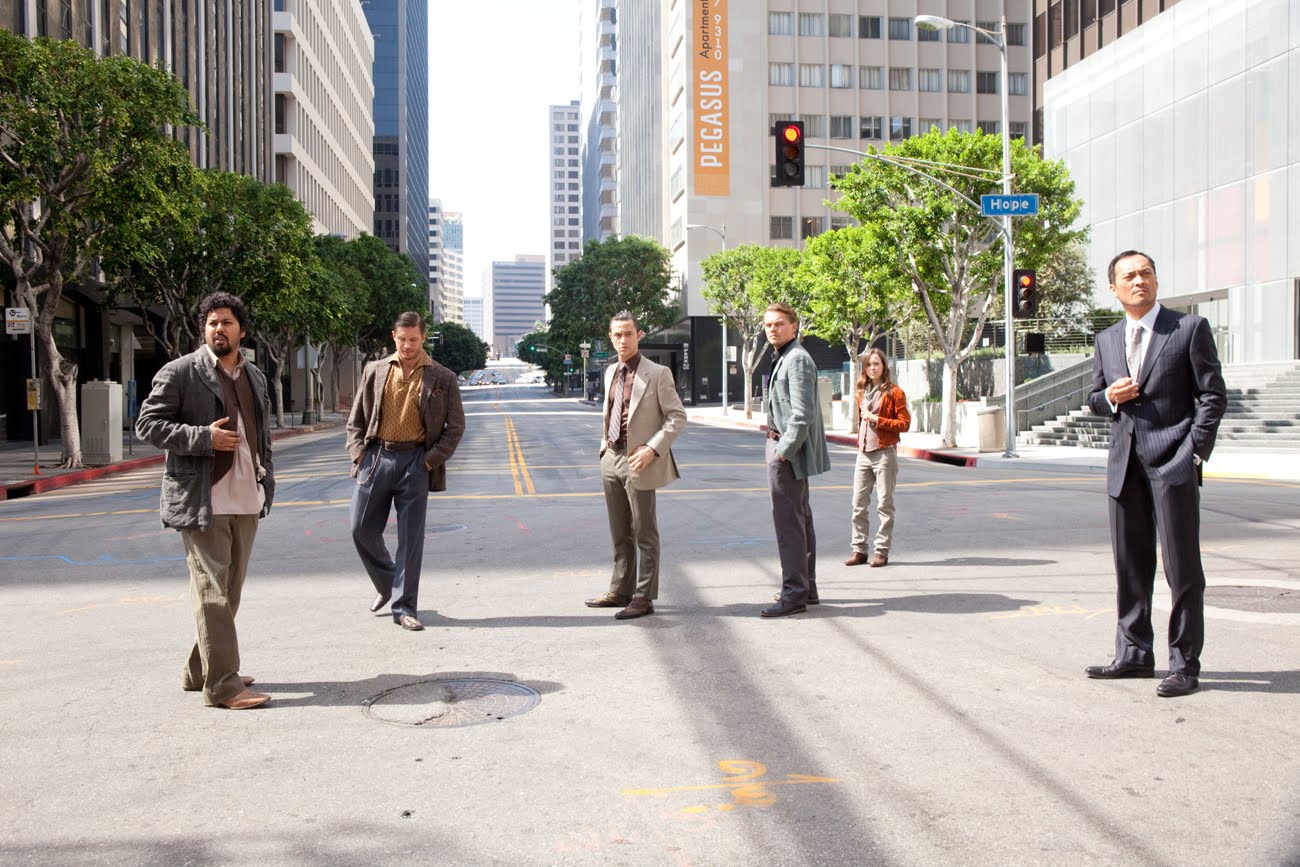
Inception’s thief is Cobb (Leonardo DiCaprio). Using a machine that fits into a suitcase — which at one point fits into another suitcase, a paradoxical visual — Cobb can boot himself into another person’s dreams, where he accesses their private thoughts to extract secrets. What he steals hardly matters; it could be the formula for Coca-Cola, Colonel Sanders’ secret recipe of 11 herbs and spices, or top secret company documents. It's simply Hitchcock’s MacGuffin: everyone wants it, but it is inconsequential to the actual plot.
Inception's MacGuffin is the sell-off of an inherited company. What the company does, or what its wholesaling will accomplish, is not important.

Once in a dream, an extractor like Cobb can manipulate the physics of the dream to a certain extent including one scene where Paris seems to fold in half like a piece of paper, and then the fruit stands explode in a parade of colorful shrapnel. And should he die in a dream he’ll simply wake up, or he can always throw himself off a tall building — after all, that dream of falling always ends before we hit the ground.

Early in the film, Cobb is hired to do an difficult, thought-impossible inception job. We learn that inception is implanting an idea into a sleeping brain, as opposed to stealing one. It's no cakewalk since a dreaming mind is not easily tricked, so Cobb and his team have devised layers of dreams that will hide the true nature of their task. By the end of the film, we’ll see four layers — a dream within a dream within a dream within a dream — with the possibility of even more layers that remain unseen. There’s also this business where five minutes of sleep time translates into hours of dream time, and on the deepest levels, a dreamer can experience decades of dreams inside a single night’s sleep. Meanwhile his real body is booted into the suitcase machine while dream versions of himself are booted into dream machines on descending levels that fall down into the rabbit hole. So climbing back out of the dreams means his subconscious must be woken up on each dream level, sometimes they require a "kick" that adds to Cobb's labyrinthine masterplan.

These are heady ideas, but the film handles them without compromising the dense science of Inception’s world. As confusing as it sounds, Nolan (who also wrote the screenplay) seems to enjoy the complexity of the challenges associated with the plot as it descends into maddening new layers of dreams and collective unconscious. His Memento was apparently light calisthenics to prepare for this. Like time-travel caper Primer before it, or even Alex Proyas’ Dark City, Inception will reward sharp or repeat viewers with further science. After I saw it, I immediately wanted to see it again, mostly because it was such a remarkable experience, but also because the plot warrants further examination.

Besides DiCaprio, who proves his talent with each new role, the film is full of wonderful actors perfectly cast in solid, impenetrable roles. There’s Joseph Gordon-Levitt (500 Days of Summer) as a dapper assistant who has different roles within different layers of dreams. In one dream layer, he has a zero-G brawl in a hotel corridor that apparently took weeks to shoot. Then there’s Ellen Page (Juno), who plays a dream architect able to design the basic structure of a dream. Cobb has her audition for the role: “Draw me a maze in two minutes that takes one minute to get out of.” Tom Hardy, who will be the new Mad Max in 2012, plays a forger who can assume the identity of others, one of them being a character played by Tom Berenger (welcome back, Tom).

These characters, as good as they are at their respective jobs, must rely much on team leader Cobb, whose dreams are easily penetrated by the subconscious taunting of his dead wife Mal (Marion Cotillard), whose name has an ominous meaning in Spanish. In one scene, she interrupts the con by sending a freight train tearing through a place that definitely was not meant for a freight train. Although separate from the dream infiltration sequences, this plot element with the wife really allows Inception to expand on the idea of dreams: that dreams are the unrepressed images of our unconscious fighting to express themselves to our conscious self. Eventually, the film becomes more about what reality ultimately is and isn’t, which leads us into Matrix territory. But what the Matrix movies couldn’t do in three movies, Inception does in just one.

Few films can invent their own worlds, let alone their own brand of science. And few films can juggle so many elements so smoothly. The bigger, more innovative, more ambitious movies become the more they expose themselves to risk. Yet here’s Inception, as bold and ambitions as sci-fi movies can get, and Christopher Nolan makes it look so simple with his latest, easily the best film of the summer, and probably the entire year.

Don’t bother pinching me; I’m not dreaming.

(I like the photos so I'm posting all of them!)

Even more despicable 3-D; stop it already!

Despicable Me has its cute moments — the little doe-eyed children, the caricature-like animation style, those impish yellow minions and their squeaky little banter. But underneath this cutesy icing is a very confused cake.

For starters, it’s a movie about a villain. The most obvious plot arc in a movie like this would involve this villain doing horrible, despicable crimes but eventually growing a conscience, understanding the moral implications of his actions and becoming an upstanding human being who waters his lawn, waves at the milkman and, oh I don’t know, doesn’t steal the freakin’ moon. But that’s in a better movie. This movie justifies the criminal’s crimes by having him read his (kidnapped) children bedtime stories — “Good story, dad, all is forgiven.”


We begin with Gru (Steve Carell), a round gothic thug in the mold of Uncle Fester. Gru is a supervillain. The movie is not shy about this element. Don’t go assuming there’s a caped hero that will figure into this; maybe he’s fled to a better movie. And don’t look to Gru to fill those hero shoes: he begins Despicable Me as a lecherous villain and ends it as a lecherous villain … with adopted children.

How he gets these children seems to go against everything we’re taught in the first scenes: See, supervillains can take whatever they want, be it the Times Square JumboTron or the Great Pyramids. (And why would Egypt try to cover up the theft of their landmarks? It makes no sense.) This kind of thievery renders borrowing money and adopting children pretty much null and void. Yet that doesn’t prevent the film’s three writers to concoct lengthy scenes involving Gru pining for cash at the Supervillain Savings & Loan Office and adopting children. He’s a supervillain — just steal what you want, dummy!


The writers also go to great lengths to show Gru as just another member of the community even though he uses Bond weapons on the Starbucks line, his car is propelled by a Saturn V rocket booster and his house, looking creepier than Dracula’s tool shed, is clearly not HOA compliant. No one involved in this movie considered how irrational it looked to have a supervillain doing villainy in suburbia while the neighbors simply gawked in disbelief in their Izod polos.

And what does Gru or any other supervillain get out of stealing the Pyramids? Or the moon? Is there some kind of ransom? Does the moon hold some larger purpose? Is it a conspiracy to disrupt surf contests? The answer to all these questions is the same: the writers didn’t want you to use your brain while watching this movie, so don’t ask. The internal logic of the film makes absolutely no sense. It’s a flawed concept that wasn’t properly flow-charted by someone who was in a position to question the logic of what happens.


So what does happen: Gru wants to steal the moon, but first he must fake-adopt the children capable of stealing a gun that shrinks things. The gun must also be used as collateral for his moon-stealing loan. He adopts the three little girls and, of course, grows attached to them even though he’s using them for his nefarious plot. The movie excuses Gru’s behavior by making the kids sweet little orphans who are being used in some equally nefarious Mary Kay-like pyramid scheme. So actually Gru’s not that bad and the kids show up to play with lasers, sleep in hollowed out bombs and disrupt his life in all the right ways. And by the end, he’s still a villain, just a villain with three kids.

The movie’s animation is engaging and colorful, although the horrific 3-D darkens all those pretty colors into a soupy mud. I did love the Minions, Gru’s chatty jumpsuit-clad henchmen, who occupy every frame like little yelping gnats that are summoned by Gru’s call. And speaking of Gru, Steve Carell proves something I’ve known for a long time: major stars should stop doing character voices in animated films.


I didn’t much care for Despicable Me. It yawned out a story that made absolutely no sense, and the writers need to be taken to task over it. Will parents like it? Not nearly as much as a Pixar movie, which has more creativity in its brow sweat than this film’s entire life cycle. But will children like it? Of course, because it has a fart gun that will make your 8-year-old howl with delight.

Thursday, June 17, 2010

A fitting finale for a beloved franchise

With their combat grips, bendable poses, interchangeable outfits and intricate moving parts, toys shepherd us from infants into teens. We grow attached to these bits of molded plastic, so much so that they become ingrained in our memories as much as specific events or people.

That is the theme of Toy Story 3. That’s been the theme throughout all the Toy Story films, but in this third one it’s expanded on and deepened to a level where it becomes a meditation on childhood. No longer a child, Andy, the owner of all the fantastic Toy Story toys, has grown up and is heading off to college. As he cleans his room one last time, he finds his old toys stuffed in a chest. He looks down at them longingly, cherishing them for the memories they evoke. There’s a scene where the toys plan an intricate cell phone trick to lure Andy to the chest in hopes he plays with them one last time. Watch the one toy as he clings to the phone, aching as Andy seems to talk directly to him through the receiver.


Later, as college beckons, Andy bags the toys up to stow them in the attic, perhaps for his own children one day. This saddens the toys, especially cowboy Woody (Tom Hanks) and space ranger Buzz Lightyear (Tim Allen), but Andy cares about them enough to save them from the garbage and, “At least we have each other,” they keep saying.

The plot allows the bag to be misplaced and it ends up in a donation bin heading to a day care center, where they meet lots of new toys, some kind and gentle, and others that are cold and manipulative. They also meet their new owners, toddlers still prone to stick things up their noses and cause other variations of toy nightmares — at one point cowgirl Jessie has her beautiful red-yarn ponytail used as a paintbrush. The day care that had looked so promising is more like a prison sentence, which prompts some Great Escape and Cool Hand Luke references — "Not in your bunk by lights out, you spend a night in the box." — eventually leading up to a lengthy jailbreak sequence that becomes more terrifying with every twist and turn.


Under all this, though, there’s an underlying theme of sadness, the kind that comes when people grow up and have to shed the things of their youth. There is an unmistakable innocence when a child plays with a toy — the smile and the laughter are so pure and genuine. And when the toys are gone, it’s time to grow up and some of the innocence is gone. Woody craves that again. It hurts to watch him crave it. Pixar, the animation company behind the Toy Story franchise, are expert storytellers, and the scenes they’ve created (Jessie's Emily sequence from Toy Story 2, the aging montage in Up, the love story in WALL•E) are some of the most poignant and heartfelt in all of cinema. They create another in Toy Story 3, when the toys embrace their destiny and join hands in a final act of friendship. It’s one of the most heartbreaking and touching moments of any Pixar film. In the end we all want to be loved, even toys.

As for the nuts and bolts, Toy Story 3 is simply spectacular. The animation is breathtaking, with colors splashing from the screen in mesmerizing Technicolor waves. The animation is so detailed and brilliant, it seems impossible that it was even made. Watch how Woody runs down the street in a full gallop, with arms flailing and legs pounding the concrete. The lighting is especially brilliant, with each scene being cast in lovely lunar blues, soft greens or rich, warm reds evoking the golden beams of a sunset.

The voice acting is again top-notch, and all the regulars return. I never tire of Tom Hanks’ voice, nor the voices of Wallace Shawn (Rex), Pixar regular John Ratzenberger (Hamm) or, my favorite, Don Rickles (Mr. Potato Head). Slinky Dog returns, but Jim Varney, who passed away in 2000, does not. There’s an extended sequence where Buzz Lightyear’s factory settings are reset and he speaks in Spanish, which should be interesting in Arizona, a state trying its hardest to silence that wonderful language.

New characters join the cast, too, including a fashion-conscious (and very metrosexual, if not homosexual) Ken doll (Michael Keaton), a purple teddy bear who runs a toy chest like Chairman Mao (Ned Beatty), a wily little triceratops, and a lederhosen-wearing hedgehog named Mr. Pricklepants (Timothy Dalton). Some of the new characters are toys that belong to cute little girl Bonnie, who’s animated so perfectly you’d swear you were watching a real toddler. (And speaking of Bonnie, would it be unfair to wonder aloud if she's a slightly older Boo from Monster's Inc.? I think not.)

As always, Pixar’s creativity, inventiveness and sense of humor are ever present, too. Watch how the more mature toys play roulette — with a See ’n Say (Toy: “Five Monopoly dollars on ‘The cow says moo’”). Or when Mr. Potato Head transplants all his parts onto a flour tortilla and then flops around during the jailbreak. The opening scene, which mirrors the opening of the original Toy Story, imagines the dreams and playfulness of the child's mind. Great care was taken to craft these characters, the things they say and do, and the plot that contains all of them.


This series didn’t need a finale. But now that it’s here I can’t imagine it ending any other way. Pixar, with Toy Story and all its other films, has found a way to take the human spirit and transfer it into objects as inanimate as plastic toy cowboys. While watching their films we see fish, monsters, bugs, robots and cars, but what we're really watching up there is us. We’re watching humanity play out in miniature. And for us to grow so fond of these fish, these monsters, these bugs and robots — and yes, these toys — then Pixar has truly done something beyond remarkable.

Tuesday, April 27, 2010

Ebert, gaming, Panic and other randomness

Greetings to the many new readers of Pick-Up Flix after yesterday's surprise and welcome Tweet by movie critic and born-again blogger Roger Ebert. Strange enough, he didn't mention the item I thought he was most likely to mention, which was my defense for his video game blog — it's the post right below this one. Instead he plugged my review of A Town Called Panic (two posts below), which he saw months ago and also loved. Not long after Ebert's post, Zeitgeist Films also Tweeted my Panic review, which was another welcome surprise. Many thanks to Zeitgeist and Roger — they've made this writer ecstatic. (They've also made this writer use the verb "tweet" several times, which is several times too many.)

Lastly, I hate to beat a dead horse here, but my page designer and I were still arguing about this video game art topic when something struck me that seemed profound at the time. It will be my last word on the subject. Anyway, I kept thinking of these video game fans and I wondered what other kinds of art they had experienced. Not to generalize, but I kept thinking that the only other artistic mediums they had experimented with were video games, comic books, Star Wars and Japanese anime. No paintings, no poetry, no architecture, no sculptures, no great works of literature. Surely someone on that diet could not tell anyone else what is and is not art. Then this Robin Williams quote from Good Will Hunting seemed to descend from the clouds in a magnificent halo of blinding light. The scene comes at a turning point in the film, when Williams (as Sean) confronts Matt Damon (as genius Will) in a park about his attitude toward people, knowledge, life and, yes, art.

Sean: Thought about what you said to me the other day, about my painting. Stayed up half the night thinking about it. Something occurred to me … fell into a deep peaceful sleep, and haven't thought about you since. Do you know what occurred to me?
Will: No.
Sean: You're just a kid, you don't have the faintest idea what you're talkin' about.
Will: Why thank you.
Sean: It's all right. You've never been out of Boston.
Will: Nope.
Sean: So if I asked you about art, you'd probably give me the skinny on every art book ever written. Michelangelo, you know a lot about him. Life's work, political aspirations, him and the pope, sexual orientations … the whole works, right? But I'll bet you can't tell me what it smells like in the Sistine Chapel. You've never actually stood there and looked up at that beautiful ceiling; seen that. If I ask you about women, you'd probably give me a syllabus about your personal favorites. You may have even been laid a few times. But you can't tell me what it feels like to wake up next to a woman and feel truly happy. You're a tough kid. And I'd ask you about war, you'd probably throw Shakespeare at me, right, "Once more unto the breach dear friends." But you've never been near one. You've never held your best friend's head in your lap, watch him gasp his last breath looking to you for help. I'd ask you about love, you'd probably quote me a sonnet. But you've never looked at a woman and been totally vulnerable. Known someone that could level you with her eyes, feeling like God put an angel on earth just for you. Who could rescue you from the depths of hell. And you wouldn't know what it's like to be her angel, to have that love for her, be there forever, through anything, through cancer. And you wouldn't know about sleeping sitting up in the hospital room for two months, holding her hand, because the doctors could see in your eyes, that the terms "visiting hours" don't apply to you. You don't know about real loss, 'cause it only occurs when you've loved something more than you love yourself. And I doubt you've ever dared to love anybody that much. And look at you … I don't see an intelligent, confident man … I see a cocky, scared-shitless kid. But you're a genius, Will. No one denies that. No one could possibly understand the depths of you. But you presume to know everything about me because you saw a painting of mine, and you ripped my fucking life apart. You're an orphan right?
[Will nods]
Sean: You think I know the first thing about how hard your life has been, how you feel, who you are, because I read Oliver Twist? Does that encapsulate you? Personally … I don't give a shit about all that, because you know what, I can't learn anything from you I can't read in some fuckin' book. Unless you want to talk about you, who you are. Then I'm fascinated. I'm in. But you don't want to do that, do you sport? You're terrified of what you might say. Your move, chief.

This single scene probably won Williams the supporting actor Academy Award in 1997, and probably helped win Damon and Ben Affleck the original screenplay Oscar. Not all of it applies to my point, but the part about art, love and war do. If life is a video game, then gamers should acquire a certain amount of XP before they can comment definitively about art. After these gamers live full lives, and possibly experience other mediums of art, maybe they'll feel differently about video games. Or maybe they'll feel the same. Either way, it hardly matters because Yahtzee is right: what is and isn't art is entirely up to the individual looking at it, or playing it.

Monday, April 26, 2010

Video games aren't art ... yet

Roger Ebert, you gotta love him.

Here he is in the worst physical shape of his life following a tremendous (and victorious) battle with cancer and the many surgeries that have left him unable to speak, and yet he’s at his writing peak, churning out movie review after movie review and writing some of the most thoughtful prose of his career on his blog, one of the smartest and most insightful on the entire Internet.


First he angered creationists by rebuking their need to have the “science” of creationism taught in school. Then he turned his guns on Glenn Beck, who he said any rational human being, Republican or Democrat, should despise. Then he outed himself as a longtime Alcoholics Anonymous member, an AA no-no.


And that’s how it goes; nothing’s really off limits: health care death panels, new-age medicine, the “festering fringe” of the anti-Obama movement and textbooks in Texas. He also talks about nice, happy things, like memories of his father, the Champaign-Urbana neighborhood he grew up in, stories of his late reviewing buddy Gene Siskel. But the meat and potatoes of his blog are really his careful articulation of controversial subjects.


Last week, Ebert posted a blog titled bluntly, “Video games can never be art.” And then, seemingly, the world lit on fire and started plunging toward the sun … at least according to every video game fanboy with an Internet connection. This group of people, bless their heart, don’t hear “no” very often judging by the anger exhibited in their responses. The largely anonymous group of game junkies will convict you of blasphemy if you don’t show pious respect to Mario, Zelda, Sonic the Hedgehog or Master Chief. And boy did they convict Roger.


Nearly overnight, the article tallied up more than 1,600 comments, 98 percent of them in strong disagreement of Ebert’s assertion that video games will never be art. (Comments now number more than 3,500.) Ebert argued: “Let me just say that no video gamer now living will survive long enough to experience the medium as an art form.”


One assumption that gamers make, one they get all wrong, is that Ebert says all films are art. Nope. He said film as a medium is an art form, although most films are not art. For example, Armageddon is not art, although cinema as a medium surely is. He does suggest (through consistent reading of his work) some films that can be classified as art — many of Ingmar Bergman’s films such as Cries and Whispers, works by Akira Kurosawa, last year’s Synecdoche, New York, or Michael Haneke’s Caché — for the way they examine the intricacies of the human condition. I agree with his assessment of film as an artistic medium, the same way I agree that hip-hop is an art form, although I can’t name you one Ghostface song that should be comparable to the works of Monet or Mozart. On the same plank, video games as a medium surely can be art, though no game yet has exemplified itself as art.

Although Ebert’s entire argument is critically flawed since he apparently has never actually played a video game, he still brings up some valid points, like why do video game fans feel that they must have their time-sucking hobby validated — “Bobby Fischer, Michael Jordan and Dick Butkus never said they thought their games were an art form.” He suggests they keep playing with his blessing, as they surely will.


What he really brings up, though, especially later in his replies to comments, is the nature of art: What is art, and what isn’t art? By and large, video game enthusiasts feel that (a) if it’s beautiful it’s art, like Flower, a game where you play as a flower petal and blow through grassy fields. (b) If it includes a moving story it’s art, like Bioshock a retro sci-fi shooter set in an underwater world. (c) If a game gives the player choices it’s art, like Heavy Rain a cinematic murder mystery. (d) Or if the puzzles require comprehension at an advanced level then it’s art, like Braid, a Mario-like platformer where the player can manipulate time. Gamers also argue that any combination of these attributes makes a game art.

Surely some games are beautiful, some games are challenging, some have involving stories and well-written characters, and some are created by visual artists of the highest caliber. But these alone don’t make a game a piece of art, or more specifically, a piece of fine art. This is where Ebert got it right even if there is a growing movement of people who will call anything art, from their ergonomic desk to their kitchen toaster. No, art shouldn't be so exclusionary that nothing is art, but it also shouldn't include everything because then it yields the same result — nothing is art. Ebert simply suggested we demand more than health bars and ammo packs from artwork.

I think art has to stir something deeper in the soul than just beauty, or invigorate the brain with something more than just puzzles. I think art must speak to elements of the human spirit, examining who we are at our core. A movie like Synecdoche, New York surely does that. The works of Picasso do too. As does Fallingwater, Frank Lloyd Wright’s fusion of architecture and nature. But Halo 3? It’s closer than most video games, but still has some distance to climb to reach the lofty pedestal of fine art.

Gamers need to be realistic: Yes, games like Halo 3, Bioshock, Heavy Rain, Call of Duty: Modern Warfare 2, God of War III, Flower and Braid are fun, and they also look amazing, but what do they say about us as a people or civilization? At their core, games are about jumping and shooting — essentially mashing buttons on a controller — to beat the boss and win. Some games stray from that formula, but usually not far.


If I must label anything in the gaming community art I lean toward the sandbox gaming of products — I use the word “products” intentionally — like Grand Theft Auto IV. No, I don’t think the game itself is art, but I think the way it provides an open world and then allows the players to interact with it is more artistic than anything mentioned in the Ebert blog comments. Players are given a sandbox to explore. Some do just that, explore; others get in a car and mow down pedestrians with reckless cruelty.The player’s identity is reflected in the way they play the game the same way viewers are reflected in perplexing ways in Anish Kapoor’s Cloud Gate sculpture in Millennium Park, in Ebert’s own city of Chicago. Of course, a game like GTAIV would be more artful with just a city and the tools in which to realistically interact with it, but the designers give players missions, objectives and storylines, which then dilutes the artistry of the open-world choices. Other games, like Heavy Rain, give the illusion of choice, but really the formula has already been written. These sandbox games, though, really do give freedom in a digital world teeming with life.

The bigger question is this: Who said video games wanted to be art? The Rolling Stones never sat around whining that they weren’t art. They wanted to be rock’n’rollers, and they wore that title like a badge of honor. Video games should be happy to be bad-ass shooters, or sleek ultra-modern adventure thrillers, or perplexing visual riddles. I can admit, at least, that video games can be art, which is more than Ebert is willing to admit. The medium is full of artistic opportunities. We just haven’t seen any yet. And if Ebert’s debate does anything, then it should challenge video game designers to think on a higher plane, to design a game worthy of the Louvre or the Met, not just the TV rooms of every 14-year-old with idle thumbs.

Thursday, April 15, 2010

In this town, Panic is the name and currency

In a single breath A Town Called Panic is a genius of absurdity and also a whimsical farce. The fact that it stars characters named Horse, Cowboy and Indian — and they are played by little plastic toys in the shapes of a horse, cowboy and indian — adds to its unmistakably zesty magic. How, you will ask yourself, did adults channel their inner 5-year-olds to make this? I’m still pondering that question myself.

Indian and Cowboy decide one day to build Horse a barbecue — why a horse would want to barbecue anything is charmingly never explained — so they get online and order 50 bricks. But due to a computer typo, 50 million bricks are delivered. The delivery trucks number so many that they create a roaring stream of traffic near Cowboy and Indian’s farm. With a mountain of bricks outside the front door, now the two friends must hide their mistake from Horse, who is smarter and more mature than both of his roommates. Where they hide the bricks, of course, is impossible, but it's hilarious they're not noticed sooner.

I love that plot. I especially love telling people that plot, because it prompts all kinds of questions, some more absurd than the film itself: Why celebrate a horse’s birthday? Aren’t cowboys and indians typically rivals? Wouldn’t their credit card be declined before ever successfully ordering 50 million bricks? Questions like this are valid, until you see A Town Called Panic, and then you realize that nothing quite lines up in the nutty meringue of the film’s delivery.

What a wacky movie this is. It comes from Belgium, based off a world created in several shorts by the film’s directors, Stéphane Aubier and Vincent Patar, who also do some character voices. The voice acting is French, but the English subtitles are hilarious on their own — Horse, for instance, frequently says, “No probs” to things that most farm animals would definitely have cause for concern.

Panic is shot in the most rudimentary style of stop-motion animation, though the film’s blissful mood is so contagious you won’t much care that the movements aren’t completely smooth. Many of the characters stand on the little plastic platforms that keep some toys from tipping over. The film assumes we know this, and it gets a laugh out of us, as does nearly every visual, from the enormous waffles in the vending machines to the lava spewing from cell phones.

I’ve explained the bricks, and how Horse, Indian and Cowboy live together on a farm — though Horse lives indoors, uses the Internet, reads the newspaper and has his own bed, while the slightly dumber cows graze in an adjacent field without complaint — though there’s so much more to it. Like how the trio journey to the center of the earth to play cards on a rock teetering above the molten core. Or how they encounter a giant robot penguin whose main purpose is to hurl snowballs on unsuspecting creatures hundreds of miles away. Or how a disco is held where the postman (Postman), local law enforcement (Policeman), various farm animals and a red tractor can party on a lighted dancefloor. How and why these and many other hilarious antics happen I will let you discover; just know that it all proceeds in this refreshingly illogical kind of stupor.

A Town Called Panic is not playing anywhere near where you’re reading this article, unless you happen to be in Europe or perhaps near several obscure theaters in California or New York. Why offer a review of a film you have no chance of seeing until its DVD release, you ask? Because I want A Town Called Panic to showcase the talent and originality that comes wrapped inside film festivals. I saw Panic at the Phoenix Film Festival this past weekend. It was the 10:15 p.m. screening Friday night. I think 11 people were in the theater. And we all surrendered ourselves to this charming, nonsensical movie.

The Phoenix Film Festival is not the greatest of film festivals. It’s certainly no Cannes, Toronto or Sundance. But what it does exceptionally well is introduce new films — even new kinds of films — to audiences that would otherwise be unable to see them. Only a handful of people in this state were able to experience the giddy magic of A Town Called Panic. Next year, when I see another gem, I want there to be more than 11 people enjoying it with me.