Tuesday, September 24, 2013

Feel the Rush: F1 history lesson impresses

In the disco era, there was nothing more rock ’n’ roll than a Formula 1 driver. They rolled out of bed, untangled their driving suit from their one night stand’s underwear, sped to the track, downed a shot, chased it with some champagne, puffed some weed and off they went in their little “coffin with wheels.” The patch on their driving suit reads, “Sex: Breakfast of Champions.”

Maybe they weren’t all like this in the mid-1970s, but James Hunt was a unique creature, especially in Ron Howard’s Rush, an incredible analysis of one of F1’s most epic racing feuds. The film is told from two points of view: one from British driver Hunt (Thor’s Chris Hemsworth) and the other from Austrian virtuoso Niki Lauda (Daniel Brühl). Other than being fantastic drivers, the two couldn’t be more different. Hunt, handsome and charming, walked around the pits without his shoes on. Lauda, exacting and talented, probably slept in his. The Austrian orbited around an all-consuming singularity — winning. Hunt’s motivation was simpler: defeating Lauda.

One of the more rewarding aspects of Rush is how Howard treats these two figures — the charismatic Hunt, and Lauda, dubbed “King Rat” by the other drivers — with such gentle compassion and careful framing. He likes them both, and it shows in their separate sequences, as well as in the kinetic racing scenes they share. A shrink could write psychological profiles on audience members’ favoring of one driver over the other. “So you like Hunt, which means you are wild and passionate, capable of throwing the rules out the window and flying by the seat of your pants.” Or, “You identify with Lauda because you don’t care what people think about you and you feel that caution and restraint are admirable qualities.” The movie is a litmus test for your own attitudes about competition and winning.

It’s also an engrossing story. It begins in Formula 3, where Hunt and Lauda begin their rivalry. Hunt seems to thrive by instinct alone; Lauda by knowing his engine and knowing the tracks he’s racing on. They immediately dislike each other, which is magnified exponentially when Lauda buys his way onto a Formula 1 team. “You can do that!?” Hunt groans to his team. Before long, Hunt’s on his own Formula 1 team and the rivalry continues.

Lauda is the better driver, but Hunt has style; if Lauda plays classical, then Hunt plays jazz. Their opposing methods are clearly evident at the German Grand Prix, a beastly 14-mile track called the Nürburgring, which sounds like someplace very evil in a J.R.R. Tolkien book. “A place of shadow,” Gandalf would say. Lauda protests the race citing weather concerns, but the other drivers think it’s a ruse to cut a race from a season that Lauda is likely to win. They all balk at his protest and the race continues amid dangerous conditions. Midway through the race, Lauda is in a nasty accident that nearly kills him. His car spins out and hits a wall, trapping him inside leaping gas-fed flames. You can YouTube the real footage of this crash, but it’s terrifying. The Rush version is only slightly less grisly, if only because that’s an actor and pyrotechnics and not a real human being inhaling fire as he fights seat restraints.

I’m giving away too much of the movie, but if you’re still reading this, it’s likely you’re a F1 fan and already know what happens. Lauda goes through an intense (and abbreviated) recuperation, while Hunt goes on and wins a bunch of races. In the end, it all comes down to the Japanese Grand Prix at the base of Mt. Fuji, where Hunt and Lauda will have to duke it out in the last race of the season. I will let you discover how it ends.

The technically proficient Howard, who reinvented fire for Backdraft and space movies for Apollo 13, does little for racing cinematography in the first half of Rush. The shots, while thrilling and lively, don’t reinvent driving or race cars, not like John Frankenheimer’s Grand Prix did in 1966. Many of the shots involve static setups of cars careening around corners, or blurry side-by-side shots of F1 cars zipping down tracks. In a word, the races are bland. They do get much better, though, especially during the pivotal Nürburgring and Fuji races, which are exhilarating exhibitions of speed and drama. Howard and screenwriter Peter Morgan (Frost/Nixon) imbue the film with so much F1 trivia and authenticity that you’ll start to appreciate why Howard was on the starting grid at every F1 race for nearly two seasons — he was proud of the film he was working on. Current F1 fans will appreciate the name dropping and vintage cars, including that wacky six-wheeled Tyrrell car.

Better yet are the performances by Hemsworth and Brühl, who rise to the challenge of playing these complicated men with their dangerous hobbies. Now that he’s been Marvelized as Thor, I forget that Hemsworth can really act. And terrifically, too. He has a toe-tapping montage set to the Spencer Davis Group’s hit “Gimme Some Lovin’” and a sequence where we see his method of memorizing every turn and gear shift of a track. The wonderful Olivia Wilde has a small thankless role as his wife, who can't sustain him in his wreckless phases so she jets off to have an affair with Richard Burton. Brühl, who most will remember as the Nazi sniper and propaganda poster boy from Inglourious Basterds, is something to behold here. He has a scene set in the Italian countryside that is just splendid. It begins when a pair of Italian Ferrari fans (Lauda drove for Ferrari at the time) insist he drive their car after his breaks down. They sit in the back of their own car grinning like fools as Lauda pilots the jalopy around hairpin turns and up country hills. 

This is an incredible picture, but my only concern for Rush is that people won’t see it. It happened with Cinderella Man, Howard’s 2005 Depression-era boxing movie. It was a great movie, but it didn’t have an audience. After several miserable box office weekends, the studio told theaters to start issuing refunds to customers who didn’t like the film. The idea was that it would get butts in the seats, and then they were unlikely to ask for a refund because, after all, Cinderella Man was a fantastic movie. I’m very curious who the audience is for Rush. Formula 1’s largest audience is not in the United States, which largely prefers NASCAR and light beer over F1’s more challenging style of racing.


My hope is that non-racing fans discover the movie for its complex character studies, solid story and authentic setting. And if you like racing, well, then there’s a bit of racing here, too. Just a smidge.


Friday, September 13, 2013

De Niro vs. Meta-De Niro in The Family

Robert De Niro’s batting average fluctuates wildly. Many years ago, he was doing one stellar movie for every two movies made. Nowadays he’s averaging a homer about once every three at-bats. He’s a star, no doubt, but he swings at too many pitches.

Now, to follow this baseball analogy through to its end, The Family is not a grand slam, although it’s certainly the wildest inside-the-park homerun you’re likely to see for a very long time.

This is a strange, strange movie. So strange that I find myself at a loss for what it really is. At its heart, it’s a gangster movie, with De Niro doing his trademark mobster routine like a salty old pro. But it’s also a relationship drama about a Brooklyn family struggling to tough it out in the FBI’s witness protection program. There are subplots involving the water company and his daughter’s handsome teacher, monologues about olive oil and peppers, a curios middle section in which De Niro’s mobster-in-hiding plucks away at his memoirs in a greenhouse and a surreal scene at a film debate that turns absolutely bonkers.

Also, the whole movie takes place in Normandy, France, miles away from where American soldiers blasted their way into Nazi-occupied Europe. The setting seems odd, until The Family features its own military invasion late in the movie.

De Niro plays Giovanni Manzoni, an Italian gangster in hiding after he turned state’s witness for the FBI. He’s a rat, though not a proud one as he is unceremoniously shuffled from house to house, often in his scruffy robe, under the protection of his FBI handler (Tommy Lee Jones). The feds set the family up in a quaint cottage in Normandy; their cover is that Giovanni, under the name Fred Blake, is an author writing about D-Day, a subject which the town’s residents have a deeper more nuanced understanding of.

After living a life of crime, this family doesn’t mess around. Fred’s wife, Maggie (Michelle Pfeiffer) is rebuffed at the local market when the French store clerk laughs at her request for peanut butter — “This is why all Americans are fat,” he says with an upturned nose. She does what any red-blooded American mob wife would do: she burns the grocery store down. Meanwhile, Fred’s teen children, Belle (Glee’s Dianna Agron) and Warren (John D’Leo), hit the high school with a vengeance: Belle assaults three people on the first day, including one with a tennis racket, and Warren sets up an extortion and bribery business that yields surprising results. Apples don’t fall far from the tree in this family.

While his wife and kids rip through the town, Fred shambles around the house plotting his next move. He has to be careful, though, because his old mob family still has a price on his head for ratting them out. The first order of business is to bury the seafood salesman in the garden. He tried to inflate lobster prices on the wrong guy, so Fred killed him. This is our first taste of violence, and it won’t be the last. Later, when he decides his water is coming out of the tap a little too brown for his liking, he takes on the town’s plumber, the mayor and the fertilizer plant owner. “We’re not in Brooklyn anymore,” Maggie tells him.

De Niro has done these gangster roles before, so it’s no surprise that he can do this one — a mash-up of his characters in Goodfellas and Analyze This — so well. De Niro’s performance is lazy and tired because poor Fred, beat up in this FBI program, is entirely defeated. De Niro’s meta-performance winks at us from behind those sad eyes because it knows we have seen the films it’s referencing. It will remind many people of The Freshman, Marlon Brando’s awful gangster movie that assumed its audience and characters had all seen The Godfather.

The Family doesn’t invoke The Godfather — don’t forget, De Niro starred in the sequel — but it does have a wonderful scene in which Fred/Giovanni is asked to debate a movie at his town’s local film club. The film: Goodfellas. All the FBI handler can do is roll his eyes. When it comes time for Fred to discuss the film, he can either play dumb or gush about the mob life in exorbitant detail. Guess what he does.

De Niro is impressive here, but so are the actors playing his family, Pfeiffer especially. Her Brooklyn accent floats in and out, but she plays the mob wife with such a feisty zest that you’ll hardly notice. Agron, usually confined to Glee’s two bland chords, finds some different notes to play here as the teenager with the dangerous crush on her teacher. D’Leo, a relatively new face, is also electric. His teen character has a recurring gag about swearing in front of his parents. “We’re not in Brooklyn anymore,” his mother says again.

The Family is a sharp comedy, maybe too sharp for its own good, which is why the whole thing was destined to end in a hail of gunfire and violence. I should have seen this coming, mostly because the movie is directed by French action auteur Luc Besson (La Femme Nikita, The Professional). With Besson, creator of the Transporter series, of course this has to end with hitmen unpacking crates of silenced machine guns, tactical shotguns, military-style assault rifles and bazookas. Of course they all have to unload on Fred’s beautiful villa. Of course a swath of mayhem must be cut through this beautiful town and its quant inhabitants.

The violence is especially cold and heartless, even for a comedy this dark. Women, children, teens, police officers, firefighters … no one is spared. In the big battle sequence, Fred’s neighbors, who we’ve come to know through the course of the film, all pop out of their gates to see what the commotion is. The mobsters kill them all one by one. Yeesh.

Aside from the violence and some meandering segments in the middle, I rather enjoyed The Family and its snarky characters. The dialogue is especially witty, even as it descends into a swear-a-thon and then into De Niro’s vast library of mob-isms. You’ve seen this De Niro performance before, but never like this, and that is the film’s charm.


Thursday, September 5, 2013

Riddick franchise gets much-needed jolt

“There are bad days, and then there are legendary bad days,” Vin Diesel’s lumpy muscleman says in hard-boiled narration during the opening moments of Riddick.

Today is most definitely one of the latter, although Riddick doesn’t have many lounging-in-sweatpants days or eating-cereal-out-of-salad-bowls-while-watching-Cartoon-Network days. So how he judges good days from bad seems to be determined by how much murder he commits. Today there is murder, though not an exorbitant amount. Give him a day or two to catch up.

I will not hide my true feelings about the Riddick franchise: it seems entirely unnecessary. Certainly Pitch Black was interesting as a sci-fi horror experiment, but I would have never guessed it could launch an entire string of sci-fi murderfests. My estimation was reinforced with 2004’s The Chronicles of Riddick, overproduced, overcooked, overwritten space schlock. It was to Pitch Black what The Scorpion King was to that Mummy movie that spawned it — it was the red-headed step-child. Surely, the franchise was dead now, right?

Nope.

Now here we are with Riddick, a movie so impossibly redeeming to the franchise that I’m actually looking forward to the next entry. Yeah, folks, Riddick is fantastic, devilishly so. It shocked me how fun it was. I could have left the theater to find Vin Diesel personally washing and detailing my car and I would not have been more surprised than I was with Riddick, with its wacky sense of purpose, its macabre humor and Diesel, glowing as he plays the galaxy’s unluckiest ultimate warrior.

The movie involves a simple premise, to which the movie will forever be in its debt: Riddick is marooned on a planet by villains from the last movie. He hacks his way through the local bestiary to a remote outpost, a cop-op shack used by galactic mercenaries. He turns on the beacon to be rescued, but the beacon scans his body and alerts a fleet of hired killers that Richard B. Riddick, a wanted man with a large bounty, is the one making the call for help. Two different merc teams arrive to collect. They want Riddick, and Riddick wants a ship to fly home. And that’s all there is to it.

The first 30 minutes of the movie are the most curious, though, as Riddick hoofs it across a Martian-like wasteland. For a franchise so obsessed with needless action and laser battles, I was struck at this sequence’s slow pace: Riddick hides in a sulfer pool to escape dingoes, he wedges his broken leg in a crack to perform a maneuver not recommended by your local chiropractor, and he injects himself with a swamp bug’s venom to build up an immunity. The whole sequence creeps along at a lazy pace with Diesel’s trademark octave-dredging voice. Speaking of his voice, if the fabled Brown Note exists it must certainly exist within Diesel’s doomy rumble, often compared to an idling Harley Davidson but with more gravel and grinding. (For Brown Note history, please refer to South Park or Mythbusters.)

Eventually, Riddick activates the emergency beacon and two separate teams of killers arrive to claim the bounty. One team is made up of ruthless hooligans and murderous madmen. The other team is more professional with “matchy matchy” uniforms and a sense of integrity that must pass as space ethics in their line of work. The second team also has a lady, Dahl (Katee Sackhoff, Starbuck from Battlestar Galactica), who is threatened with rape so many times that I lost count. This is my only complaint with Riddick: in the future, in space and even on awe-inspiring distant planets men think rape jokes are funny. Even her name — Dahl, as in “sex doll” — seems like a perverse pun for Riddick’s more misogynist subset of Neanderthal fans.

Mostly, though, Riddick is campy, which is charming under the film’s unique arrangement of sci-fi conditions. Riddick, for example, roams the alien prairies with this giant Flinstones-sized switchblade made out of animal bone. In other sequences, men ride hovering jetbikes are photographed against hilariously obvious green screens. The effect reminded me of those early surf movies with a bunch of actors standing on stationary surfboards as waves were projected on screens behind them and members of the crew dumped buckets of water from outside the frame. Other Riddick campiness includes a bit with a package of outdated “crab enchilada hash” and an actual segment of dialogue wrapped around the line “take the jinx out of our janx.” Another sequence, a 10-minute segment involving an explosive combination lock on a storage cabinet, is equal parts thriller and comedy.

I’ve seen much better movies this year, but Riddick is the first high-octane action bonanza that didn’t make me roll my eyes with every new scene. It’s not high art, nor is it cinematic brilliance. But it is an entirely capable and completely entertaining big-budget action movie. And though the violence is often grisly and the tones dark, Riddick seems to have been made by people with wicked senses of humor because it shows up there on the screen.

Assuming the next franchise entry is as original as this one, this Riddick guy might have some staying power after all.


Thursday, August 15, 2013

Two sides to Jobs' coin: genius and tyrant

In Jobs, Apple founder Steve Jobs is portrayed as a genius and a tyrant in equal measure. I’m still not sure if the movie was asking me to sympathize with him or detest him.

This was not the Jobs movie I was expecting. I was expecting a fluffy 90-minute Apple commercial: “Look at how brilliant our founder was. Now go buy a Macbook.” Instead, it is an honest and occasionally brutal examination into the origins of a flawed genius. It frames Jobs as a sloppy businessman, a reckless designer and a terrible friend and father. We see the brilliant bits, too, but mostly we see a quirky designer with lots of obsessive hang-ups — his aversion to shoes and socks, for instance — that make him eternally difficult to work with, even as he engineers his revolutionary design aesthetics into the Macintosh, the iPod and the iMac.

Jobs is played by Ashton Kutcher, whose tall lankiness plays well in the Apple creator. Kutcher mimics Jobs’ hunched walk and his peculiar way of speaking. It’s an interesting performance, one that Kutcher, whose acting ability I’ve always doubted, mostly nails.

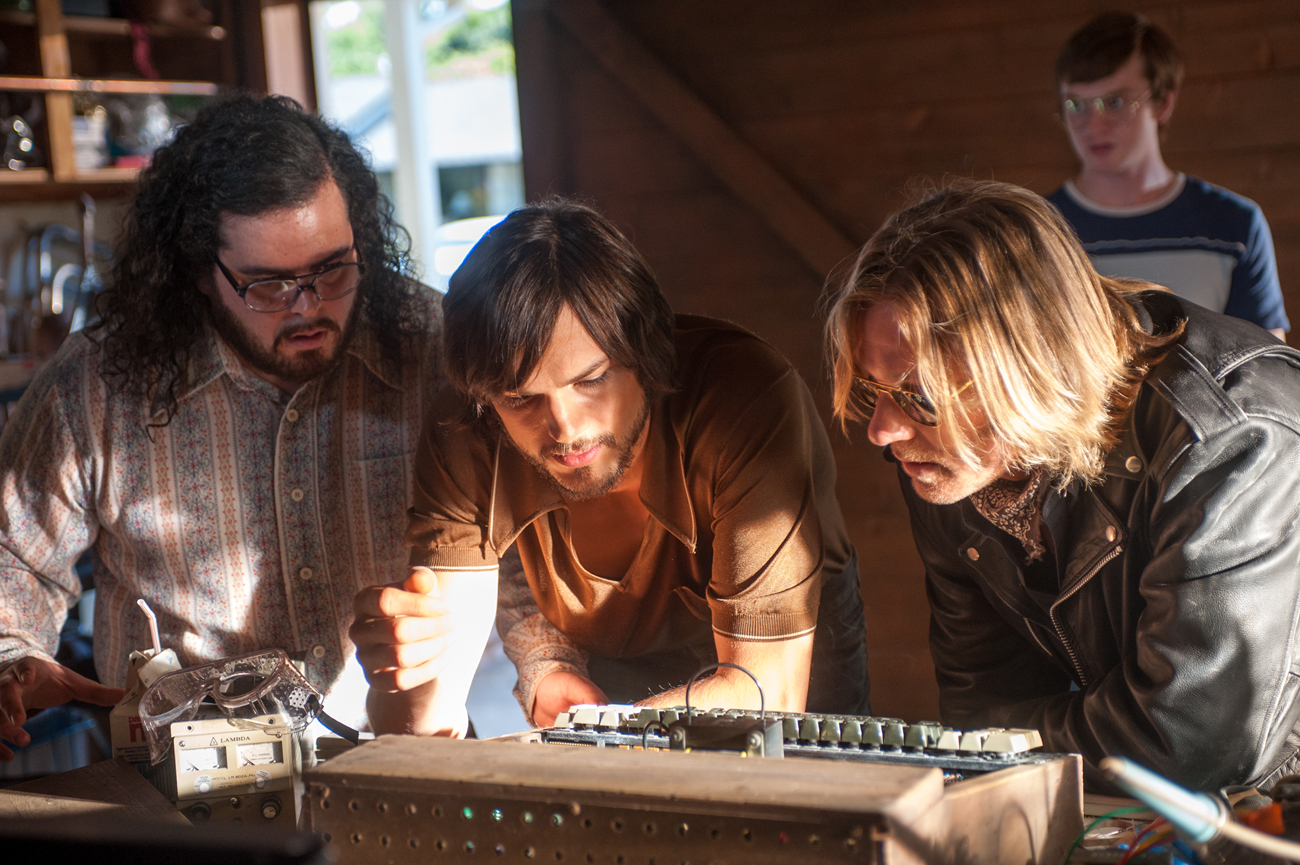
Jobs begins in the gold-tinted ’70s, when Steve and buddy Steve Wozniak (Josh Gad) are tinkering around with video games and other electronics as the industry bubbles to the surface. In a passing moment, Wozniak, called Woz by Steve, introduces a home computer he’s built. Steve can’t take his eyes off the crude motherboard; he sees potential in those soldered circuits. The two form Apple — “The fruit of creation,” Steve says, “and it comes before Atari in the phone book” — and begin pitching their first computer around the fledgling tech scene.

Jobs makes enemies out of good-natured people who stand in Steve’s way. I didn’t like this aspect, especially since the film portrays these people as early believers in the Apple brand. This happens several times with Apple CEOs, designers, engineers and important investors, but happens first with a computer store owner who shows great faith in Steve’s product by buying the first 100 Apple computers. Later, the movie seems to turn against this minor character with Steve glaring at him at a tech expo. It’s the first time we see the petty, stubborn and vindictive side of Steve Jobs. It’s not flattering.

As Apple grows, Steve and Woz recruit some friends to start cranking out their computers. They share a wonderful montage in Steve’s garage, where they all pluck along at building Apple’s first computer. It’s all bittersweet, though: Steve will eventually cast aside these loyal friends when it comes time to divvy up the money that starts crashing in. Remember when Facebook founder Mark Zuckerberg conned his partner out of millions (and eventually billions) in The Social Network? Steve does it here with four different people.

The movie deserves some kind of commendation for painting Jobs in a less than favorable light. I was expecting lots of pro-Apple worshiping, but Jobs seemed bored by its subject’s marketing potential. Instead, it really did stick to Steve Jobs’ complicated personality, even as he became a detestable wretch at certain points in his career. Well, most of his career. We see him explode when he doesn't get things he wants. We witness his juvenile way of speaking to people, and how that temper is used to manipulate those around him. In an Apple II design meeting, he fires his best designer because he suggests that the font choices are not critical components. “Make the small things unforgettable,” Steve says calmly after a seething fit.

These are unflattering scenes for the Jobs legacy, but they do reinforce his particular brand of thinking. Steve says repeatedly that Apple doesn't make computers; it makes tools for life. And how people use those tools is what shapes the world they all live in. Steve was adamant that his vision be preserved in all of Apple’s products, from the computer casing and color choices right down to the fonts and the click of the mouse. “We’re gonna put a dent in the universe,” he says toward the end.

Still, though, I find the Steve Jobs worshiping troubling. At the end of the day, regardless of the brilliance of the iPhone or iPod, Jobs was a businessman. His ultimate goal was to make money. The movie reinforces this cold hard fact by showing him withholding money from those he deems unworthy of it. Jobs also asks us to have sympathy for him after the Apple board has him removed in 1985 after a failed coup. Steve plots his revenge from a mansion so large that the film can’t frame the whole thing in one shot. That kind of wealth does not inspire me the way it does the Apple cult. Yes, his designs were elegant and his ideas grand, but I think history books will downplay Steve Jobs’ role in technology. This movie agrees with me.

That being said, Jobs is still an interesting dissection of the Steve Jobs myth. It held my attention constantly, although I did find myself more drawn to Gad’s goofy performance of Wozniak than to Kutcher’s too-serious performance of Jobs. The movie also introduces too many elements that aren't given proper consideration. For instance, early in the film, he finds out he’s going to be a father. The idea so frustrates him that he contemplates signing over his parental rights to the child’s mother. But then at the end of the movie, the teen daughter is living in his house. The movie glossed over what must have been a difficult process of acknowledging his role as a father, especially since Jobs himself was adopted. He can't go from disowning the child to serving the child Fruit Loops on the patio without some sort of explanation.

Some Apple purists are going to be upset by this review, especially since we — myself and Jobs — aren’t bowing at the feet of Steve Jobs and his tech legacy. Full disclosure: I own and happily use Apple devices overseen and designed by the late Apple founder. They’re great products. Now read that last word again: products. Jobs didn't cure polio. He designed some popular electronic gizmos. And he made a great deal of money doing it. He’s only human, and Jobs proves that.


Monday, August 12, 2013

The Spectacular Wow

A monotonous static growls in the margins of most movies about teens: sex, drugs, prom, Friday-night football, cafeteria cliques, weekend keggers. It’s a rare film that can find a way to work without, or against, that well-established mantra. And The Spectacular Now is a very rare achievement, indeed.

Simply put: it is a uniquely written, marvelously acted and confidently directed film about the perils of falling in love when your compass still hasn’t found true north. It is one of the finest movies this year. And yes, it’s spectacular.

It is directed by James Ponsoldt, an up-and-coming director with an endless knack for framing the delicate and profound beauty that bubbles up from within the madness of addiction. He also believes in long, unbroken shots that allow his actors to, you know, act. In last year’s Smashed, a devastating portrait of alcohol abuse, Ponsoldt spun sympathy and dread around a terrifyingly young woman consumed by drink. Here, less than a year later, he again focuses on alcoholism, but also on another unfortunate addiction: people.

In comes Sutter Keely, the most popular student at his high school. He’s one of those kids with so much confidence that he needs a second backpack to carry it all around in. He’s constantly winking, smirking, plotting … at any moment he could explode from his seat and pinball down the locker-lined hallways. He loves the attention that swirls around him; he thrives off of it. Popular teens in movies are portrayed as cruel bullies, but not Sutter — he’s sincere and gentle, kind even. In the opening reveal, we see him in all his glory: at a party, beer in hand, diving into a pool with all his clothes on. His girlfriend, another elite member of his high school, has dumped him because he always lives in the now, never thinking of his — or their — future. He leaves the party and sneaks into a nightclub, where the warm blanket of bodies at the bar and on the dancefloor give him comfort. 

We truly meet Sutter the next morning. He’s passed out on a stranger’s lawn and he can’t find his car. Aimee, the newspaper delivery girl, finds him and lets him tag along until he gets his bearings. They strike up a friendship and then later a geometry study group. When she invites him into her room, he admires her nerdiness: unicorn figurines, kitten posters and Japanese manga on the bookshelves. The next day, in a sweet scene, he buys and starts reading one of the books on her shelf. She smiles — beams, actually — when she recognizes his innocent effort to learn more about her interests.

He invites her to an outdoor party, where they walk through the woods and kiss. They begin a dazzling and dizzying relationship, one that looks like a desperate rebound to Sutter’s friends, like a fire hazard to Aimee’s. Of course it looks odd: he is hyper and unrelenting, and she is fragile and studious. Somehow they balance each other out.

I could stop there and you’d think this were a romance (it is) or a relationship drama (that too). But it is volumes more. It’s about teens confronting their problems with brave faces. It’s about fathers and mothers, how their shortcomings reflect on their children. It’s about intimacy, but not so much about sex. It’s also about underage drinking, but without being preachy and underhanded. Sutter introduces Aimee to hard liquor, even gives her a flask as a gift. Here’s the honors student who first refused beer now sipping shots between lunch and fourth period. Their shared habit grows concerning, but the film refuses to address it further because its very existence is acknowledgment enough.

Mostly, though, The Spectacular Now is about being young. Sutter and Aimee are so carefree and likable that you can’t help but think of your own high school experience, back when the entire world seemed to hang on those first parties, those first kisses, those first heartbreaks.

This all probably sounds so audaciously simple — and it is — but The Spectacular Now looks upon all this with a fresh set of eyes and with two remarkable young actors who are capable of conveying all the doubt, the embarrassment, the confusion and ecstasy that comes with first loves. Sutter is played by Miles Teller, whose elongated face and scarred chin do nothing to halt Sutter’s fierce charisma. Sutter walks through life glowing and he knows it, and Teller captures that essence with a knock-out performance. Aimee is Shailene Woodley, who played George Clooney’s daughter in the Hawaiian family drama The Descendents. Woodley bares her heart here as Aimee, the girl no one looked twice at until Sutter turned his white-hot spotlight on her. Throughout most of the movie it looks like Woodley wears little or no makeup, and still she radiates.

This movie is one for the ages, at least as far as high school movies are concerned. Where Fast Times at Ridgemont High and Dazed & Confused were windows into particular points in time, and the teens swarming within, The Spectacular Now is more a window into the souls of two teens who are increasingly torn about the next step in their relationship. Aimee yearns for a ranch, a job at NASA and husband very different from herself (“It keeps things interesting.”) An adult tells her it sounds like a dream. “I think it’s good to dream,” she says. Sutter thinks only of the “now” and never the future, and he’s much more complicated, especially when he comes to learn who his father is. The film has a brutal and honest exchange between Sutter and his good-natured boss. “If I were your dad this is where I’d give you a lecture or something,” the boss tells him. Sutter replies back: “If you were my dad you wouldn’t have to.”

The movie touches on that mantra I discussed earlier, but it doesn't obsess. Prom and graduation come and go so quickly they feel like abbreviations compared to other movies. And even those scenes are turned upside down. Prom, for instance, has a tender moment where Aimee can clearly see Sutter's ex-girlfriend on the dancefloor. She could be jealous and spiteful, but she insists they dance. Maybe she's testing Sutter's love, or maybe just testing her own. Other scenes, including a violent argument with a shocker ending, prove how raw and real this relationship has been written. These aren't your typical teens; they love and lust, argue and bicker, second-guess and self-doubt like real teens. By the end of the film, long after graduation, we have a troubled near-alcoholic kid, who has so many abandonment and daddy issues that he can barely acknowledge the perfectness of the girl who seems ready to right his veering ship. And we also have a love-worn girl who fell for the first guy who laid eyes on her, and he brings her down more often than she lifts him up. These are mesmerizing figures, and also a little tragic.


This is a beautiful movie directed by a fantastic new director and starring two talented actors playing complexly written teens. The movie doesn’t reinvent high-school movies, but it does peel down a layer to reveal a deeper humanity at the core of every teen. Maybe you’ve made some regretful movie choices this summer — I know have. Do yourself a favor and go see The Spectacular Now, one of the best movies of the year.

Thursday, August 8, 2013

Take two Elysiums and call me in the morning

Elysium sounds like one of those drugs advertised during daytime TV: “Side effects of Elysium may include drowsiness, bleeding of the eyes and throat, trouble making rational decisions, gas and bloating in public places, fear of small animals and birds, and the development of a fatal allergy to air. Consult your physician before trying Elysium.”

Strangely enough, the movie Elysium has some side effects, too: boredom, eye rolling, frustration, anxiety, clock watching and sporadic armrest clawing. “Consult your movie critic before trying Elysium.”

Groan, groan, groan … this summer is terrible. Even the movies I sorta enjoyed — Man of Steel and Pacific Rim, for instance — I would prefer to never see again. Don’t even get me started on the ones I hated, chiefly The Lone Ranger or Pain & Gain. As for the box office: everything is failing. Hollywood hasn’t seen this much red since the McCarthy Era.

Elysium was the last bastion of hope this summer. After all, its director —South African wiz kid Neill Blomkamp — made District 9, the underdog sci-fi movie with the big clicking cockroaches and the hulking space ship serving as an umbrella for an entire city. District 9 was great and it made people a believer in Blomkamp’s talent, especially since he did the movie independently and without a bajillion dollars in studio-backed money. Our trust in his work might have been a little misplaced, though. Now here he is with Elysium, with lots more money and big-studio support. What could possibly go wrong?

Lots, my friend. Lots.

The film takes place in 2154, in a (more) ruined Los Angeles with a distinctly dystopian vibe, with robotic police officers walking around harassing parole violators and line cutters. Everyone is poor and sick and generally miserable. Water is undrinkable, food is scarce, and employment can be attained at a cruel defense contractor’s massive factory, where radiation ovens yawn out for human flesh. This is where we meet Max (Matt Damon), one of those parole violators. Max is a former car thief turned Blue Collar Joe trying to earn enough so he can rocket off Earth to Elysium, a giant spindle-like space station orbiting Earth.

As you will quickly discover, Elysium is a heavy-handed metaphor about class and social hierarchy. Mostly though, it’s about racial inequality. Los Angeles, filmed with a yellow tint, is diverse and cultural. Elysium is filmed in blues and greens and almost everyone is a creamy white, including Jodie Foster playing a defense secretary whose whole face frosts up wickedly when she finds out trespassing ships are approaching her elitist colony. “Oh no, Mexicans!” says the faces of every person in the control room.

Class warfare and the growing wealth gap are great ideas for movies, but not here and not like this. This is just silly with that giant spinning Malibu up in space with the Hobby Lobby floral arrangements hanging from every plastic wall and molded contour. Even stranger is how the film switches its theme from the expanding wealth gap to illegal immigration. It’s a subtle shift, but it suggests that maybe Elysium doesn’t know what it’s about. By the end, when characters are re-animated in med-pods and citizenship can be granted by a computer worm, neither will you.

Back to Max: he hatches a plot to get on Elysium, but it involves hacking a living brain before he himself is hacked into itty bitty pieces by Kruger (District 9’s Sharlto Copley). Kruger is a mercenary, and even though he has tactical nukes, chemical railguns, homing death Frisbees, imploding hand grenades and a Jedi force field, he still uses a samurai sword in battle. It would be like a Marine deploying to Afghanistan with a slingshot and some marbles, but nevermind. Damon’s Max is not without his flourishes: after a terrible wound, Max is tricked out with a iPod dock in his skull and a hydraulic exo-suit that screws right into his bones. He’s hammered together in a montage that reminded me more of Ikea furniture than of sci-fi mechsuits. By the way, if your surgeon ever tells you that “we gonna cut you up real good, homie,” then you might need to reconsider that surgery regardless of its importance.

The movie trailers are really playing up Damon’s exo-suit thingy, but it’s vastly underpowered. Sometimes he’s super-strong; other times, he seems mostly normal, but with a bunch of windshield wiper arms hanging from his body. And just look at him: that is the one of the dopiest movie costumes since that one Johnny Depp movie (any of them). Damon, for his part, is a good sport about everything and he does try to work around Elysium’s needlessly complicated action formulas. The same can’t be said for Jodie Foster, who is just off in every way an actress can be. Foster is a great talent, but this is some sloppy work with those uneven tones, strange stop-and-start deliveries and that painful look on her face as she flatly speaks her sleepy dialogue. Her character decides to start a coup and she has one of those cliché lines with the president: “No, sir. I’m running the show now. You had your chance.” Snore.

The crux of Elysium’s problems is that everything it does has been done better in District 9: mech-suits, futuristic gunfights with deadly high-powered sci-fi weapons, provocative themes involving class warfare, hovership battles, chase sequences, Sharlto Copley … I could go on, but I’d eventually have to re-review District 9, which, trust me, sounds more fun. (Speaking of which, if you haven’t seen it yet, go for it.) Elysium just fumbles everything it lays its hands on. It has an especially hard time justifying a mother character and her child, as well as a best friend character played by Diego Luna. These are pointless additions that do nothing for Max and even less for Elysium.


I will say this, Elysium is ambitious. To its detriment, though. So ambitious that it loses sight of the little things that made Blomkamp’s previous picture so wonderful. Spectacle is nifty and all, but if it’s attached to nothing then what’s the point? 

2 Guns 2 Many

Buoyed to the center of this vacant parcel of eternity called 2 Guns are two genuinely likable people: Mark Wahlberg and Denzel Washington, who are apparently out of money.

Did they buy fancy yachts recently? Cliffside homes in Monaco? Was there a bulk discount on some Monet paintings somewhere? I ask these questions because I grow concerned for their financial security. Both of these actors know what good scripts look and sound like. They know the rhythms, the nuance and all the other little quirks that turn mediocre movies into gems. Because they know these things — and because they found none in 2 Guns and still signed up to be in it — I must wonder if they took on this stupendously overcooked movie for the continuation of their craft or for a payday. If they're photographed with their boats or wakeboarding on their Monets anytime soon then I guess I have my answer.

Washington plays Bobby Trench, an undercover DEA agent, deep inside a Mexican drug cartel. Wahlberg plays Bobby's sidekick Stig, an undercover submarine captain … or was it an undercover sail rigger? I forget — just know he's a Naval officer working undercover in the Sonoran Desert, which is a laughable brand of irony. Even though law enforcement agencies have channels to verify and confirm other undercover agents, these two dopes have no clue they're playing for the same team. They finally get clued in when Stig sees Bobby's DEA badge after he shoots him and leaves him for dead in the desert, conduct very becoming of a member of our armed forces; and when Bobby identifies the make and model of Stig's sniper rifle pointed at him from 100 yards away and in the dark. "My, that dark splotch you're holding that I can barely see looks military. Are you an elite military operative, Stig?"

Each entraps the other to rob a bank of a couple million bucks. But then the bank is hiding a CIA slush fund worth $43 million, a bulky sum that turns everyone against everyone: the Navy against the DEA, the DEA against the CIA, the CIA against the Mexican cartel. (The NSA chuckles silently in the background of every phone call.) So convoluted are the alliances that at one point the Navy is fighting side-by-side with Stig and then in the very next scene they're villains. Apparently there are so many double-crosses that not even the movie itself can keep up. Making matters worse is the drug kingpin, whose name is Papi, which sounds so much like "Bobby" that I began to doubt the meaning of even the most basic dialogue. It made me wonder if anyone had actually read the script out loud before filming started. This give me hope for a movie I'm writing about a team of assassins all named after Roman numerals.

2 Guns is made from the bones of better movies, and from the skin and teeth of some deplorable stinkers. When it isn't lobbing us mindless action sequences and regurgitated gunplay bonanzas, it's filling the screen with cliché after ham-fisted cliché. The scenes of cops buying donuts and a detective guzzling Pepto Bismol right out of the bottle are particularly worn and tired. Even worse are Bobby and Stig's incessant griping at one another, even mid-shootout, because nothing is funnier than watching two men who will never get shot pretend they might get shot while they bicker about the plot's most microscopic aspects, like yogurt. (Full disclosure, I did enjoy Wahlberg's deadpan yogurt request in a soon-to-destroyed kitchen.)

Director Baltasar Kormákur must have studied the Michael Bay catalog of films to accomplish so little with so much. A lot happens in his movie, including multiple car chases, gunfights, fistfights and scenes of torture and interrogation. Frequently, these scenes end with violent executions for no other reason than to create a malevolent villain. The deeper Kormákur gets in his twisted tale, the more lost he finds himself. I'm still unsure of what side a female DEA agent was on, or if she was even on a side. Maybe she was an ordinary civilian undercover as a DEA agent for, you know, a research project or something.

Although Wahlberg and Washington do their best to rise out of all this muck, they can only do so much and then we must question their ability to pick movies with wanton abandon. I will say this: Wahlberg is much better here than he was in Pain & Gain, the worst film of 2013 so far. Washington is more perplexing. He just doesn't belong here and I'm not sure why he is here. He's certainly picked duds before, although this time he's noticeably working on autopilot. 

Who I question more of, though, is Bill Paxton as the CIA agent. He plays this honky-tonkin' Texan with a big ten-gallon hat and bolo tie. It's a cross between John Huston and Foghorn Leghorn. He's unnecessarily cruel and spiteful, which is unbecoming of Paxton's limited range. His Texan is also a bit of a fibber: in one scene he threatens to turn on the American military might, up to and including "Apache helicopters with Hellfire missiles" or something like that. But then later he shows up in a '70s-era Huey like it's Vietnam. You can almost hear the Creedence as the copter sweeps in low for machine-gun fire. I guess the movie ran out of money to make the Apache thing happen.

Paula Patton plays the other DEA agent, the one whose allegiances are still a mystery to me. I just finished watching an interview with Patton in which she says that she chose to do a nude scene in 2 Guns because it just "felt more natural after two characters — mine and Denzel's — had just made love." I commend her brave, nude quest for some cinematic realism, but did she not read the rest of the script? There's a shootout in a cattle stampede. Then the Texan with his Nam copter. A drug dealer buries chickens up to their wings and then uses their squawking heads for target practice. Later, a cartel kingpin, who urinates on his own hands for moisturizer, is called, and I quote, "a Mexican Albert Einstein." Paula Patton's threshold for realism is apparently so low that her next nude scene will be in a Skittles commercial.

I hate movies like 2 Guns; I also, incidentally, hate 2 Guns as well. I would like to say that Denzel Washington and Mark Wahlberg feel the same way and that no amount of money would get them to make a tired, old movie that better movies run circles around.

I would like to say that, but can't.

That line you just read was where my print edition of this review ended. Since then, I've spoken with several people who tell me they enjoyed 2 Guns because it was "action and shooting and explosions." I can't review movies for people who give a movie a passing grade if only because "things done get 'sploded." We should all hold our movies to a higher standard, even films within the action genre. That being said, if all that tickles your undercarriage is gunplay and explosions, and not so much plot and characters, then maybe 2 Guns is the movie you deserve.