Showing posts with label Comics. Show all posts

Thursday, August 6, 2015

Fantastic 4 is a monument to comic awfulness

If there is ever a museum for bad movies — and let’s all agree there should be, and it would be great — then the bronze monument at the entrance should be of the Fantastic Four. The plaque at the base can read: “Four heroes. Four films. Three franchises. Each fantastically awful.”

Chalk it up to divine intervention, Murphy’s Law, Chaos Theory, karma, Marvel’s pride or whatever, the universe will simply not allow the Fantastic Four to flourish. The disastrous race to beat expiring movie rights doomed 1994’s straight-to-video cheap-o-rama version. In 2005, an updated and CGI-heavy reboot, and its woeful sequel with the Silver Surfer two years later, bombed in an entirely new way with its characters, who bickered and sniped at each other like spoiled children. And here we are once again with a new Fantastic Four, and all new ways to wreck a film in spectacular fashion.

Marvel, the comic book company that now makes interlocking movie mosaics, has had a long and powerful run at comic movies. So long and so powerful that some people — people like me — are praying, hoping, cheering for the company’s eventual failure in Hollywood, which might just loosen the grip that superhero movies have on the cinema it has hijacked. Fantastic Four might not be Marvel’s death knell, but it’s proof that Marvel isn’t bulletproof. So ready, aim, fire on this clay pigeon of a movie.

Quantifying how bad this film is really very easy: it’s bad in almost every way. The actors are just atrocious, with dialogue that is forced and delivered in a drab monotone. The director, Chronicle helmer Josh Trank, is clearly out of his league with too many moving parts, an uneventful plot, a cast that is largely on screen to deliver meaningless exposition, and outdated, frankly embarrassing CGI. The pacing is off, with a long buildup to zero climax. The action choreography is uninspired and clunky. Even the score is dismal, its hollow notes punctuating the movie’s desperate failings. So little is done right that you can start to see why Trank, during the post-production of Fantastic Four, dropped out of the Star Wars spin-offs — that franchise might finally have its bearings, and Trank simply wasn’t cutting it. 

We begin with Reed Richards, a little kid in grade school called up to give a presentation about what he wants to be when he grows up. He expresses a genuine interest in science and discovery and the teacher laughs him back to his seat, because teachers just humiliate their students into submission. This is the first scene, and already I was laughing at the unintentional awfulness of Fant-four-stic, which is what the Internet has already dubbed it. Later, Reed and his new friend, Ben, who lives in what can only be described as an orphanage at a junkyard, borrow an industrial strength power converter to test out a quantum transporter. After blacking out the neighborhood, the toy car they transport disappears and in its place is a handful of foreign-looking space rocks. If this sounds interesting and slightly mysterious, don’t worry the film drops this completely so put it out of your mind. 

Years later, Reed and Ben (now played by Miles Teller and Jamie Bell) are apparently in their early 20s and participating in a sixth-grade science fair. Even stranger still, super-secret government science contractors, including Sue Storm (Kate Mara), are trolling the little kids’ baking soda volcanoes and potato clocks for insight for their own experiments. When they see the quantum teleporter they kick Ben back to the junkyard and give Reed a full-ride scholarship to continue testing his device. Back at their lab, Reed meets Sue’s brother Johnny Storm (Michael B. Jordan), some Fast & Furious reject who can weld, and Victor Von Doom, whose name indicates he will most certainly be the villain. Doom is a hacker, something we know because he sits brooding behind six computer monitors, one of them plays video games and the others have streams of code scrolling down all Matrix-like. Also, Doom doesn’t shave — he’s angsty. 

The movie seems to be moving along at a decent clip, and then it just keeps on going, blissfully unaware that it’s on the wrong road entirely. As 10 minutes stretches to 20, then 30, then 45, Fantastic Four still has no plot, which is odd because this is the third franchise featuring this origin story, so we know what happens. It’s not a mystery: Reed, Sue, Johnny and Ben are exposed to cosmic radiation and turn into mutant superheroes. It takes an agonizingly slow 45 minutes to get to the mysterious planet on the other side of the quantum teleporter. At the 55-minute mark the four finally get their powers, and only at the 90-minute mark do all of them share the same frame together as the Fantastic Four. The whole movie is 100 painful minutes long — only Marvel’s mercy saved us from more.

By the time Reed is a super-flexible Stretch Armstrong doll, Sue can turn invisible and create blue energy orbs, Johnny can fly and turn into a fireball, and Junkyard Ben is made of rocks, the film has already overstayed its welcome. Even worse, the actors have largely checked out, including the great Teller, so wonderful in last year’s Whiplash and here left to give impassioned pep talks with no passion or pep. He just lets the dialogue flop out of his mouth, especially in the anticlimactic finale where he pleads for unity among the four. “Alone we can’t beat him, but together we can,” he says in a voice meant for reading world news briefs on NPR. Mara has the regretful line, “I’m not going to be a tool,” and an early scene where she blurts out that she listens to music because of “pattern resolution.” Jordan and Bell have few lines, and maybe it’s best for them and their promising careers. The lines they do have reveal no depth to their characters or to the world they inhabit. 

The acting is just the worst, and the only excuse I have for these fine actors giving these awful performances is that maybe these were the performances Trank wanted. Or maybe the actors just turned it off once they realized the plot was a literal black hole. In any case, this is abysmal acting with no heart, no humanity, and certainly no payoff within Fantastic Four. It starts bad and only gets worse from there. When Doom’s black hole does open in the last 15 minutes, I was grateful that the first things sucked in were the Fantastic Four.

I suspect, as have others, that the reason the film has these abbreviated character storylines and why it takes so long to get going is because it’s building Fantastic Four’s world. The idea being that the universe is established here in this film, and then explored deeper in subsequent films, like Marvel’s Avengers universe. If that’s true, and I believe it is — proof: a Fantastic Four sequel was announced before this one was even released — then Marvel is the greatest risk to film since flammable film stock. The cinema has its troubles: writers are fleeing to TV, 3D is still a dastardly grift, and these abhorrent prequels, remakes and sequels will just never end. But these shared universes are going to ruin everything. That might sound like an overstatement, but Fantastic Four is a prime example of what happens to projects that focus on whole networks of films and not just the film at its feet. You end up getting an undercooked, overwritten piece of story filler that’s meant to take your money now, next summer and every summer after until it gets absorbed by one of Marvel’s other franchises. Its not the art of film; its a pyramid scheme. 

This has to stop. And Fantastic Four’s epic failure is a step in the right direction. 

Saturday, August 1, 2015

Ant-Man points deeper down the Marvel pipeline

Ant-Man as a stand-alone film would be a nearly perfect summer superhero movie. It has a likeable hero, an appropriately evil villain, jokes, a love story, sidekicks, a sage old mentor, a train sequence (something every movie can benefit from) and a suit that allows a man to shrink to the size of a grain of salt. 

But Ant-Man is not a stand-alone movie. It’s a Marvel movie, which means it must give shout-outs to the Avengers, to Captain America, to the incoming Spider-Man, to other films and other franchises. When a character whistles “It’s a Small World,” is that because the movie is about shrinking people or because Marvel is owned by Disney? At some point the “Marvel Universe” ends and greedy corporate synergy begins, and that’s when this mostly witty movie turns into a hyper-linked footnote in a sub-paragraph of the third appendix of the next Avengers movie, itself a slave to the decades-long Infinity Gauntlet storyline.

This might sound blissfully orgasmic to fans of Marvel movies, but it’s maddening for me. I like movies to have beginnings, middles and ends — they should be at least mostly self-contained, even sequels. Ant-Man is like a jigsaw puzzle with all the edge pieces removed: the completed picture tells a full story, but those jagged edges are made to click into other films, other characters, other franchises. And where does that leave Ant-Man? Borderless. 

This increasingly cantankerous ranting is becoming a weekly tradition for me as I slog through another, and another, and another superhero movie. I’ll do it again in the rebooted Fantastic Four very soon, and again next year for a slew of new releases. In any case, here we are with Peyton Reed’s Ant-Man, a movie about a man who can shrink down to the size of termites and fleas and ticks. Oh, and ants. The man in the shrinking costume is Hank Pym (Michael Douglas), and he has an opening scene with Tony Stark’s father and a young lady in old-lady makeup — Agent Carter on ABC, check your local listings. “The suit is too dangerous, and the only way you’ll get it is if I’m dead,” Pym tells them.

Decades later, Pym’s technology has been discovered by a power-hungry tech corporation, which has a CEO that personally liquefies his critics if they dare speak their minds. Pym, too old to don the shrinking suit to fight him, sets a trap for a master thief, someone perfect for the new Ant-Man. He catches Scott Lang (Paul Rudd), who ingeniously uses superglue, a metal ring and some packing tape to break through a fingerprint lock. When Scott puts the suit on for the first time he thinks it's a motorcycle outfit, but then he fidgets with the buttons and whoosh, down he goes to the size of a bug. He braves a tsunami in a bathtub, stomping feet and a spinning record in a dance club, and narrowly misses being sucked up into a vacuum. The suit comes with other perks, including an earpiece that allows him to speak to four different species of ants, which comes in handy at picnics.

This is all pretty straightforward superhero movie stuff. It doesn’t deviate too far from any of the formulas established by Spider-Man, Iron Man or Batman. It benefits greatly from Rudd, though, who is genuinely charming and funny as he clobbers his way through Pym’s nemesis. One of the great early scenes shows us how Scott learns of Pym’s heist frame-up: the camera swoops into a wine-tasting event, a gangster grill-out and a softball game as rumors and tips are exchanged from one criminal to another. The film also benefits greatly from Michael Peña as Scott’s waffle-making best friend, who sums up an entire heist explanation with “We’re gonna steal some shit.”

The Ant-Man powers are especially nifty, if only because we get to see giant versions of things, including a fight on a Thomas the Tank Engine toy. The film explains that the suit allows Ant-Man to shrink to the size of an ant, but he still punches like a 200-pound man. OK, whatever — it works, though.

The movie loses focus after Scott has to break into the Avengers headquarters to steal something largely inconsequential to the plot. In the screening I was at, the Marvel fans (mostly everyone) reacted to this scene about the same way as Elvis fans at Graceland. I mostly rolled my eyes because I knew what the scene was: Marvel shamefully cross-promoting a yet-to-be-made future movie with a C-list superhero during Ant-Man. The arrogance of that is just astonishing, and it makes the film pander as a marketing hack.

But what do I know? I’m just a guy who wants to watch a movie, just a single movie, without being told about another one, a better one, that’s in the pipeline.

Thursday, October 23, 2014

From Batman to Birdman in 25 years

What can only be compared to avant-garde jazz on psychotropic drugs, Birdman spazzes off the screen in a cacophony of hammered notes, false starts, odd tempos and syncopated rhythms. Somehow it finds a tune in this wall of noise. And what a strangely melodic tune it is. 

Alejandro González Iñárritu’s film — the full title is Birdman or (The Unexpected Virtue of Ignorance) — is likely to be the most polarizing movie of the year, the Synecdoche, New York of 2014. If its nominated for a bunch of Academy Awards, like some early adopters are already suggesting, it will likely draw out a curious and varied crowd, half of which will walk out shrugging their shoulders. The other half will be on their hands and knees bowing to Birdman’s wacky eccentricities. Let the games begin. 

First of all, it’s a stroke of genius. I’ve never seen anything like it. Only Charlie Kaufman’s scripts come to mind when grasping for comparisons, but even those fall short of this film’s brain-like three-dimensional matrix of neural pathways and firing synapses. It’s not just cerebral and existential; it’s densely written and perversely styled, a supernova within one man’s exploding psyche. 

The film stars Michael Keaton as Riggan Thomson, a Broadway director, actor and writer who is carving a piece of himself into Raymond Carver’s What We talk About When We Talk About Love. Many years before the events of the film, Riggan starred in a series of comic-book movies called Birdman, and now his professional career is spent playing into and against that unfortunately bombastic legacy. Fans and detractors of his work grow bored of the Carver play but perk up when someone mentions the unfilmed Birdman 4, which is about as likely as a Terry Gilliam’s forever-gestating Don Quixote movie. 

Now, Keaton’s casting here is interesting. He was a successful ’80s actor until he was plucked out of the normal acting world and dropped into two Tim Burton Batman movies, which forever colored the rest of his career. He went through some down time, and he took some dud movies, but here he is playing what can only be described as “Michael Keaton on Broadway” in Iñárritu’s spiraling whirlwind of ideas. He’s mesmerizing, and also heart-wrenchingly honest. Truer performances have not yet come to pass. 

As Riggan gets ready for his play, he interacts with members of the theater, including a maddeningly brilliant actor (Edward Norton), a gentle theater veteran (Naomi Watts), his daughter and personal assistant (Emma Stone), his lovely ex-wife (Amy Ryan) and his hovering attorney (Zach Galifianakis), who is desperate to get Martin “Score-seez” in the theater’s seats. As Riggan interacts with all these characters, he slowly starts to unravel as his alter-ego, the likely-imaginary, possibly-real Birdman starts to fight for space in his noggin. And as Riggan plays through different variations of his theater character, so does Birdman with Riggan. 

The film seemingly takes place within one single day, but watch careful and you’ll see weeks whiz by in cinematographer Emmanuel Lubezki’s careful presentation, which includes virtuosic long takes, seamless transitions, nifty editing tricks and silky-smooth Steadicam tracking shots. The camera seems to have no limit as it bobs in and out of dressings rooms, up and down narrow stairwells, onto roofs, effortlessly through audiences or, in a signature scene, through Times Square as Riggan streaks through in his tighty-white briefs. Notice all the mirrors and reflections — never once do you see the camera. I wouldn’t be surprised if there were more special effects here than in the last Thor movie. Also of note is the score, which includes dizzying drumwork, some of which can be seen as the drummer appears in scenes as if he were a magical siren on Birdman’s shores. 

This is a brilliant movie, and it features two groundbreaking performances (Keaton and Norton) that are simply awe-inspiring. I did find the film rather hollow in sections. Riggan’s scattered brain, although ceaselessly provocative, would often circle back on itself, and while it seemed like the script was rocketing toward the sun, on reflection it was more likely static. It’s a difficult film, one that makes you dig for its treasures, one that will likely infuriate some viewers. 

Birdman is quite simply a once-in-a-billion film. I’ve never seen anything like it, and likely won’t ever again. Even when it frustrated me to no end it was still captivating and hypnotic, and as lyrical as any song, as poetic as any poem and as cinematic as any film. 


Thursday, August 21, 2014

Murder is cheap in wicked Sin City sequel

"I was born at night, but I wasn't born last night," Josh Brolin's hard-boiled avenger says to the Dame to Kill For, who coos and saunters over to him, her hips swiveling in see-through négligée, her eyes white orbs blinking seductively in the shadows. The noir drips from the screen in puddles. Bring waders. 

Sin City: A Dame to Kill For is less a sequel to 2005’s Sin City than it is an appendix of new characters and alternative viewpoints. I spent much of the movie trying to figure out why Marv, Mickey Rourke's bruiser from the first movie, was alive and well and still picking fights in that dive bar where all the strippers leave their clothes on. The answer is, of course, that this is a prequel, though even that's questionable as Bruce Willis, another dead guy from the first movie, turns up as a ghost. 

So really, don't worry about the details, because what you're going into this for is the pulpy crime drama, the stylized violence and the oozing sexuality. It also helps that the movie looks completely bonkers — panels from the graphic novel are snipped from the page and pasted hastily onto the screen using a mixture of rubber cement, grit and blood. Scenes are shot in silhouette, with accents of vivid color, using unrealistic cell-shaded backgrounds, and with dramatically noirish compositions with eviscerating shadows. The visuals are no better than the first movie, but that's OK because the first movie has yet to be topped, even as The Spirit and 300 — both children of Sin City author Frank Miller — have notably tried. 

Like the first Sin City, this one tells several intertwining stories at once. The main character, or the most main character, is Dwight played by Josh Brolin. He's one of James M. Cain's loser-heroes, a Walter Neff with a trenchcoat and a bad attitude. Dwight is skulking through the night when Ava (Eva Green) turns up and baits him, hooks hims and then, gyrating her constantly exposed breasts, reels him in. She inspires all kinds of noir monologue from him, including this gem: "She's late like always and like always she's worth the wait." Green, who slithers across the screen in fleshy curls, chews up the scenery and dialogue like she hasn't eaten since June. 

As Dwight gets wrapped up in Ava's (and Ava's Boob's) dilemma, elsewhere we meet up with Marv (Rourke), who's the protector of Nancy (Jessica Alba), a stripper who never strips, though she does a routine late in the movie that is terrifyingly aggressive even for a shady biker bar. Nancy was in the original film, and she returns here with little to do, even as she attempts to murder Senator Roark (the joyfully vile Powers Boothe), whose reach into Sin City's criminal underworld is vast. Roark also figures prominently in a plotline involving Johnny (Joseph Gordon-Levitt), a young gun with a sixth sense for gambling. Like Brolin's character, Gordon-Levitt is given lots of Raymond Chandler-inspired dialogue. "Dammit, Johnny, hate yourself when you got the time," says Johnny. 

Film noir is a Hollywood staple, and easy to mock, and Sin City lampoons it more than it honors it. But that’s not a complaint, because noir is limitless, from the high school drama Brick to the outwardly spiraling Memento. The genre has transcended Chinatown and Double Indemnity to include Sin City and all its high-contrast, black-and-white ultra-stylization. That being said, the franchise can feel very gimmicky and there are times when the plots are victims to the film's over-simplification of noir themes. Christopher Meloni has a brief chapter where he's required to play a smitten detective to Ava's femme fatale. At no fault of Meloni or Green, the sequences feel hammy and overplayed, and they reveal limitations to Sin City’s hyper-noir. 

All in all, though, this is a taut sequel with some notable performances — mostly Rourke, Brolin and Green — as well as some memorable minor performances, including ones by Juno Temple, Lady Gaga, Ray Liotta and a hilarious turn by Christopher Lloyd as a skeevy doctor-for-hire. The film is directed again by Robert Rodriguez and Frank Miller, who must have had fun bringing Miller's violent pages to the screen. Rodriguez might just be the king of exploitation, schlock, cult and other varieties of novelty B-movies, and Sin City: A Dame to Kill For is further proof he has no interest in directing a "normal" movie. That's fine by me. 

Lastly, I don't normally mention this, but if you can see Sin City in 3D do it. The graphical nature of the film, and the way it jumps out of comic panels, creates an interesting three-dimensional effect that is unique to this film. And it features the first pair of characters that are entirely designed for 3D — Ava's Boobs. Decide for yourself if that's a good or a bad thing.


Thursday, August 7, 2014

Where's Vanilla Ice when you need him?

Late in the rebooted Teenage Mutant Ninja Turtles movie, the knife-bedazzled villain Shredder says, "Tonight I dine I turtle soup." Funny, because that's exactly what I was thinking. 

In one of the most blockheaded reboots to come out of Hollywood's trendy Reboot-a-Thon, the Michael Bay-produced Teenage Mutant Ninja Turtles further perpetuates the principle of diminishing returns when it comes to re-imagining every design that was on your bedsheets when you were 7 years old. Recall how the original movies were silly fun and, yes, heaps full of stupid. Bay and director Jonathan Liebesman (Battle Los Angeles) vacuum all the color, visual gags and life from the franchise and supplant it with grit, haze and shadows. 

No one is going to try and convince you the original Teenage Mutant Ninja Turtles franchise was quality cinema. It was early '90s counterculture ("Cowabunga, dudes") wrapped up in a blank check to the pizza industry. It was kitsch and camp, rubber-faced costumes and pre-X-Games skateboard stunts. It was the kind of movie that pre-teen You loved, but if you were to watch it today be kinda embarrassed about. But the movie had pluck, and the plot and characters made sense. (Look at what the remake has done to me — I'm defending movies that are mostly indefensible.)

In the reboot, the plot is about as subtle as stomping through rain puddles in a minefield. It opens on Megan Fox as a journalist — the movie's first big joke. Fox is April O'Neil, a reporter at a New York City television station who says during a live broadcast, in Times Square no less, "Hey guys, I'm here in New York City …" Because all the viewers thought she was in Sheboygan, and she cleared that right up. The journalism stuff is all unintentionally hilarious, including a clueless editor played by Whoopi Goldberg, April's fact-free brand of reporting, and poor Will Arnett who keeps using the phrase "put it to bed" totally unaware that's an actual news term that means the opposite of what he's talking about.

April, the daughter of a dead scientist who experimented on turtles, gets a hunch about masked vigilantes trolling the Foot Clan, the city’s pesky paramilitary gang that operates in the shadows. She follows her make-believe leads until she finds the actual Teenage Mutant Ninja Turtles, hulking human-turtle hybrids with large prehistoric shells and color-coordinated masks. There is sword-swinging Leonardo (voiced by Johnny Knoxville), the leader; Raphael, the rebellious outcast; Michelangelo, the jokester and pizza fiend; and Donatello, the IT turtle who wears nerd glasses and a large headset array on his face.

The turtle’s are designed beefier and sturdier than the earlier movies. They're given lots of sewer-scavenged accessories — a bamboo chestplate, recycled sunglasses, do-rags, shell necklaces and, because whatever, a rocket skateboard — that allow them a grittier fashion sense, albeit a homeless one. The four reptiles are also entirely motion-captured CGI, giving them a creepy animated vibe. Making matters worse: none of the voice acting is convincing, or even memorable. They may be teens, but the turtles are voiced by gravel-voiced middle-aged men whose mothers couldn't pick their voices out in a vocal lineup.

Anyway, April and the turtles — and their rat leader, Splinter — team up to disassemble the Foot Clan and it's shadowy leader, who you will never in a million years guess. (It's William Fichtner and that was sarcasm.) Fichtner plays Eric Sacks, the Foot's financier who only speaks in exposition-filled diatribes. He hatches a plot to gas all of Manhattan so he can sell everyone a poison antidote. Sacks, a name that is funnier the more I read it, is willing to kill a whole bunch of people so he can be "stupidly rich," but he lives in a Bruce Wayne-sized mansion with a helicopter pad, owns numerous multinational corporations and has the mayor on speed dial — his priorities are a little screwy. 

Being that this is a Michael Bay movie, at some point a Transformer had to show up. This Transformer's name is Shredder. He's a human ninja wrapped in a metal knife-suit that could easily be mistaken for one of Hasbro's transforming robots. And like Bay's Transformers, Shredder doesn’t really have a form or shape, but rather metal tips and wings and appendages. Imagine taking a human shape and welding a junkyard to it … Shredder looks like that. 

The film’s mush of gunfights and ninjutsu is appropriately idiotic — the only thing it inherited from the original series — and takes place in the turtle's subterranean sewer plaza, high atop a skyscraper and skidding down the world's longest mountain snow slide. There are hints of zaniness, though much of it feels like a rehash of the Transformers movies, now with more reptiles. Ninja Turtles might also have the worst photography of the year: much of the movie is foggy and dark, and the 3D doesn't brighten the mud. It also doesn't help that every camera gimmick is used, from shaky cam and its stepchild spinny cam to lens flares and haze filters. It's as if Liebesman (let me repeat his credential here: Battle Los Angeles!!!) didn't want us to see his movie at all, which is actually my recommendation.

Lastly, let me talk about Megan Fox. Critics sometimes joke about bad performances, and we're prone to hyperbole, but I feel confident about this next sentence: acting doesn't get much worse than it does right here with Megan Fox. At one point she's out-performed by a pizza box, and then tube of ooze, and then four CGI turtles who live in a brick-lined tunnel made to funnel human excrement out of a city. We've know Fox was an awful actress for some time, but this confirms that she's also a glutton for punishment. She spends much of the movie being thrown from one dangerous stunt to another, but the film always has time to admire her ass. "You're a complicated chick," Arnett's character says as he drills holes through her jeans with his eyes. Fox had an epic falling-out with Bay during the Transformers movies, and supposedly she made nice to be cast here. If this is what happens when you apologize to Michael Bay, then he may never hear "I'm sorry" ever again.

So, who's ready for that soup?

Thursday, July 31, 2014

Marvel kicks it into high gear for Guardians

The best joke of the summer has no punchline, but the setup is priceless: A human, a raccoon, a green woman, a tree and a man incapable of understanding metaphors walk into a bar … If you really need a punchline, then stay tuned to Guardians of the Galaxy, and the sequel, and The Avengers sequel, and the raccoon spin-off, and the TV show, and the reboot 15 years from now, and read the comic book, and then its reboot. But that punchline will come, eventually. 
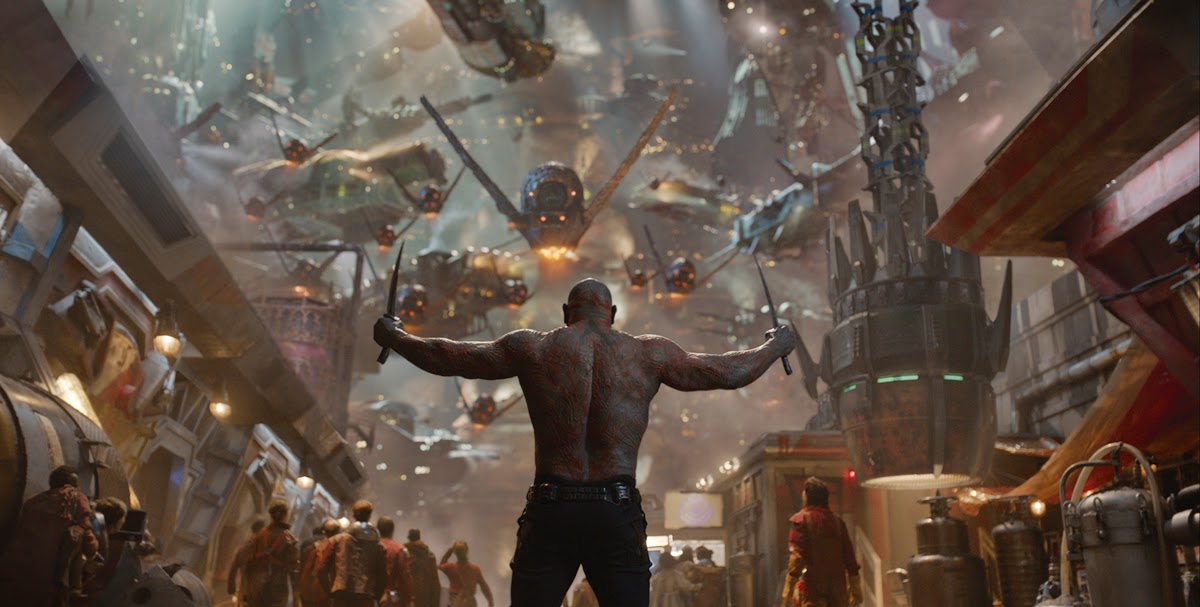
Ignore my condescension about Marvel’s franchise stretching — I really did enjoy Guardians of the Galaxy and its wackadoo cast of characters, who might not be as mighty as the Avengers, but are infinitely more interesting, funny and present. Even the raccoon, who nature tells us should be picking through the trash and clinging to human faces in Farrelly Brothers comedies, is a breath of fresh air blown over Marvel’s stable of increasingly stale comic characters. If you'll recall, Captain America slept through his last adventure, Iron Man seemed bored, Hulk is a pyrotechnic afterthought, and Thor is a third-rate thespian in an explosion-filled Hamlet. I've grown tired of these emotionally wounded men and their faltering identities, which is probably why James Gunn’s Guardians of the Galaxy feels so invigoratingly unconventional. 

The movie is set in space as salvage captain and bounty hunter Peter Quill (Chris Pratt), aka Star-Lord, cruises through the galaxy looking for space junk to sell. When he finds a metallic sphere containing a piece of soul-sucking rock, he unleashes all kinds of problems that eventually unites him with green-skinned Gamora (Zoe Saldana), alien muscleman Drax (Dave Bautista), pint-sized Rocket Raccoon (voiced by Bradley Cooper) and Rocket’s tree friend Groot (voiced by Vin Diesel), who only says 'I am Groot,' yet Rocket understands him like Timmy with Lassie. Each character has their own personality and quirks, and I found myself cheering on all of them. None of the characters have superpowers, another refreshing tweak for a comic-movie, which means they have to get out of jams using ingenuity and teamwork. 

Their teamwork shines during several high-octane action sequences in a space-prison, which they escape from without the help of a man’s prosthetic leg, and a Mos Eisley-like trading post built inside the decaying brain of a deceased space titan. The locations are something else. In the brain station, Star-Lord, Rocket and Gamora jump into mining pods to engage starfighters on the edge of space. The scene features something I've never seen before in a sci-fi movie: Star-Lord crashes through the hull of a fighter and uses his mining pod’s robot arms to fly the enemy ship. It’s a man piloting a ship piloting another ship, and it's appropriately zany. Later we meet a man who can control a single metal arrow with a whistle — I wonder what the arrow does during a basketball game. 

Our five heroes are fighting back against Gamora's ex-partner, Ronan, who is trying to recover the all-powerful rock, one of five Infinity Gems, for his boss Thanos, a stone-faced villain whose throne is definitely not eco-friendly — even the armrests have little jetpacks on them to provide comfy forearm support. Thanos is the main villain, but he’s only here to tease future films, ones that will feature even more Infinity Gems and eventually the Infinity Gauntlet, which is some kind of no-limit credit card or something. I enjoyed this movie, but this sequel baiting is annoying. Fanboys might adore it all, but it all feels kind of icky and corporate the way Marvel has spread its storylines out across so many different mediums. Somewhere a marketing director is praying to a plaque that reads "synergy." 

All that aside, though, Guardians of the Galaxy is a whopper of a franchise starter. And not since the Hellboy franchise have I been this excited about a comic-movie. Guardians soars mostly because the characters are likable and funny. And because it has a different tempo than the other earth-bound comic movies. But mostly because it’s funny. Pratt, eternally Andy Dwyer from Parks and Recreation, is the right fit here as the smart-ass space jockey. He’s a big doofus, of course, but he’s also macho enough to carry the action, which is intensely orchestrated into gunfights, space races, laser battles and martial art spectacles. He has a gag about a blacklight in his dirty space cruiser that must have shot soda out of a dozen noses in the theater I saw it in. In another great line, he says he comes from Earth, "a planet of outlaws — Billy the Kid, Bonnie & Clyde, John Stamos."

Television wrestler Dave Bautista's Drax will also be a fan favorite. Drax speaks, hears and thinks in literal terms — metaphor and symbolism are beyond him. When a prison inmate threatens one of our guardians with the old knife-across-the-throat gesture, Drax seems perplexed: "I will not drag my finger across his throat … But I will kill him." Later, it's implied sarcastically that nothing goes over Drax's head. His response: "Of course nothing goes over my head because I will catch it."

Add into all this Bradley Cooper's exasperated snickering, Vin Diesel's octave-busting "I am Groot," and the lovely Zoe Saldana all covered in green skin and you have a wild, free-wheeling sci-fi flick with a stellar cast, some genuine laughs and a damned fine soundtrack of ’70s rock. I can't ask for any more from Marvel. Except maybe fewer movies.

(The press stills are really great, so I'm adding most of them. Sorry if they take forever to load.)