Showing posts with label History. Show all posts

Thursday, December 11, 2014

Enigma to Ultra: Turing versus the Nazis

In 1952, the man who shaved two years and millions of deaths off of World War II was prosecuted for a crime so frivolous and embarrassing that the Queen would have to pardon him decades later. But by then the damage had been done in this shameful piece of history.

Alan Turing, the subject of The Imitation Game, was instrumental in the events of World War II, he synthesized a number of modern ideas about artificial intelligence, and he pioneered this great big box that would one day become the computer. But Turing was also gay, something he was punished for with reprehensible cruelty after the war. I wanted Imitation Game to be as outraged as I was, but it takes a different approach entirely: it presents Turing not as a victim, but a hero. 

Turing (Benedict Cumberbatch) was plucked from the ranks of a very talented batch of science geeks at Cambridge during the onset of World War II. He was assigned to Bletchley Park, the secret British codebreaking campus that was just starting to wrap its collective brain around the Nazi’s elusive Enigma machine.

Morten Tyldum’s careful direction and Graham Moore’s determined script present Enigma as a character in the film. The German code machine looks like a typewriter, but with a lampboard, a set of rotors, and a plugboard behind a wood panel at the base. The permutations of possible codes was almost incalculable — “millions of millions” one codebreaker says. Making matters worse, the Germans changed the machine’s codes daily, which gives the codebreakers roughly 18 hours of tinkering once the coded messages were gathered from the battlefield. While the others workers tried different combinations of plugs and rotors, Turing was looking for a shortcut.

The Imitation Game plays like an espionage thriller, because it is. In fact, historically speaking, it is the ultimate spy thriller. Turing, who was an awkward loner, spends much of the movie hunched over electronic components, dodging double-agent accusations, smuggling documents out of Bletchley Park to study at home, and fighting with his co-workers who didn’t share his ideas about his computing box that he called Christopher. Turing slogged through them, his subordinates (including Charles Dance and Mark Strong) and even Winston Churchill to get Christopher up and working with astounding results.

In one of the film’s strongest segments, Turing needs to hire more codebreakers so he plants a difficult crossword puzzle in the newspaper and watches as bewildered readers show up saying they can solve it. He ends up hiring the only woman, Joan Clarke (Keira Knightley), who falls for Turing even amid her suspicions of his orientation. They make a great pair. 

I’m skeptical of historical movies like this, because I know they condense facts, eliminate characters, make composites of others and in the end the history is lost. That is certainly true here, especially once you start diving into the details of Turing’s machine and Enigma’s follow-up project, Ultra. But the core here is Turing, and he’s just fascinating. As is Cumberbatch, who is delightful in everything he’s in.

I left Imitation Game fuming at Turing’s treatment after the war, but also immensely proud of his work during the war. If only he would have been allowed to continue working — the world might look a little different today.


Thursday, October 9, 2014

Dark Alliances: The Gary Webb story astounds

Late in Kill the Messenger, a journalist is awakened in the middle of the night by a chatty CIA operative who has come to set the record straight. "First, you're attracted to the power. Then you're addicted to the power. Then devoured by the power," the agent says in the shadows. The journalist asks, why are you telling me this? "It's my confession."

It's a pivotal moment in Michael Cuesta's fantastic new film because it reveals how bad things have become for the reporter, and how much worse they're still going to get.

The reporter is Gary Webb (Jeremy Renner) and he works for the San Jose Mercury News covering property seizures in Los Angeles drug cases. After a tip, he's alerted to a courtroom where he witnesses a rather strange thing: a major drug case is dropped simply because Webb is in the courtroom. Federal prosecutors don't want reporters poking around their key witness, a man named Danilo Blandon, so they drop all charges against a known drug kingpin. This only arouses the curiosity of Webb, who plunges headfirst into the crack epidemic of Los Angeles of the early 1990s.

Renner, channeling his inner Sean Penn, punches his way through this true story with ease, like he was destined to play Webb. But that could be said about many of Renner’s roles — he's just phenomenal every time. Renner plays Webb like a crusty proto-punk clad in frayed canvas, Metallica and Rancid posters on the garage wall, shaggy hair billowing from his head and chin. When his son asks for advice, it's a priceless nugget: "Don't let the assholes win." Webb is relentless, a characteristic that will bring about his rise and eventual fall.

While researching the elusive Danilo Blandon, Webb ends up at a criminal trial for a mid-level drug dealer who has a great line about his boss — "I was an elf. He was Santa Claus." Because he can't get to Blandon directly, Webb waits for him to take the witness stand and then feeds questions to an attorney from the front row of the courtroom. Under oath, Blandon drops a bomb: his boss was not another drug kingpin but a CIA operative. This game-changing fact sends Webb deep down the rabbit hole of government secrets. After trips to South America, countless interviews, prison visitations and a dangerous tour of an airport for drug planes, Webb connects the dots: the CIA was using drugs to fund contras in a secret war in Nicaragua, a war that congress refused to fund. 

Webb's story, with the headline "Dark Alliance," shook American politics like an earthquake. And for awhile he was a media celebrity who received appearance requests from Montel, Jerry Springer, and 20/20 or 60 Minutes, as long as he would appear on one but not the other. A White House official, sympathetic to moths and flames, tells him, "My friend, some stories are just too true to tell." But Webb told it. And then it all collapsed. 

The downfall started mostly out of professional jealousy. The big papers were sore that the itty bitty San Jose Mercury News and it's plucky no-name reporter scooped them. The CIA funded the drug epidemic, but the media was more interested in Webb's reporting style. They were frenzied piranha until nothing was left of Webb. It was not a proud moment for journalism. 

Kill the Messenger is a sensational journey through Webb's story. I couldn’t take my eyes off it. Cuesta gives the story an immediacy and documentary-like feel with handheld cameras, inserts of drug busts and money-filled apartments, and he lovingly frames Renner as an old-school shoe-leather journalist, a martyr for the truth, a reporter who cut his own path through a story.

The film has an incredible cast, including Tim Blake Nelson as a defense attorney, Rosemarie DeWitt as Webb's wife, Oliver Platt and Mary Elizabeth Winstead as overwhelmed editors, and Barry Pepper as a slimy federal prosecutor. A number of great actors have only single scenes, including Andy Garcia, Robert Patrick and Michael K. Williams. Ray Liotta, in a perfectly simple one-off scene, plays the trespassing CIA agent with the existential crisis. 

The film does not leave the impact of Webb's work up in the air. It states clearly that the CIA colluded with drug dealers to sell crack cocaine in the United States and to use the money they made to fund a war in South America. You might disagree with that prognosis, but Kill the Messenger has solid reporting speaking on its behalf. The film ends with political heavyweights confirming much of the CIA plot.

Gary Webb was right all along. 


Thursday, February 6, 2014

Monuments Men no work of art, but that's OK

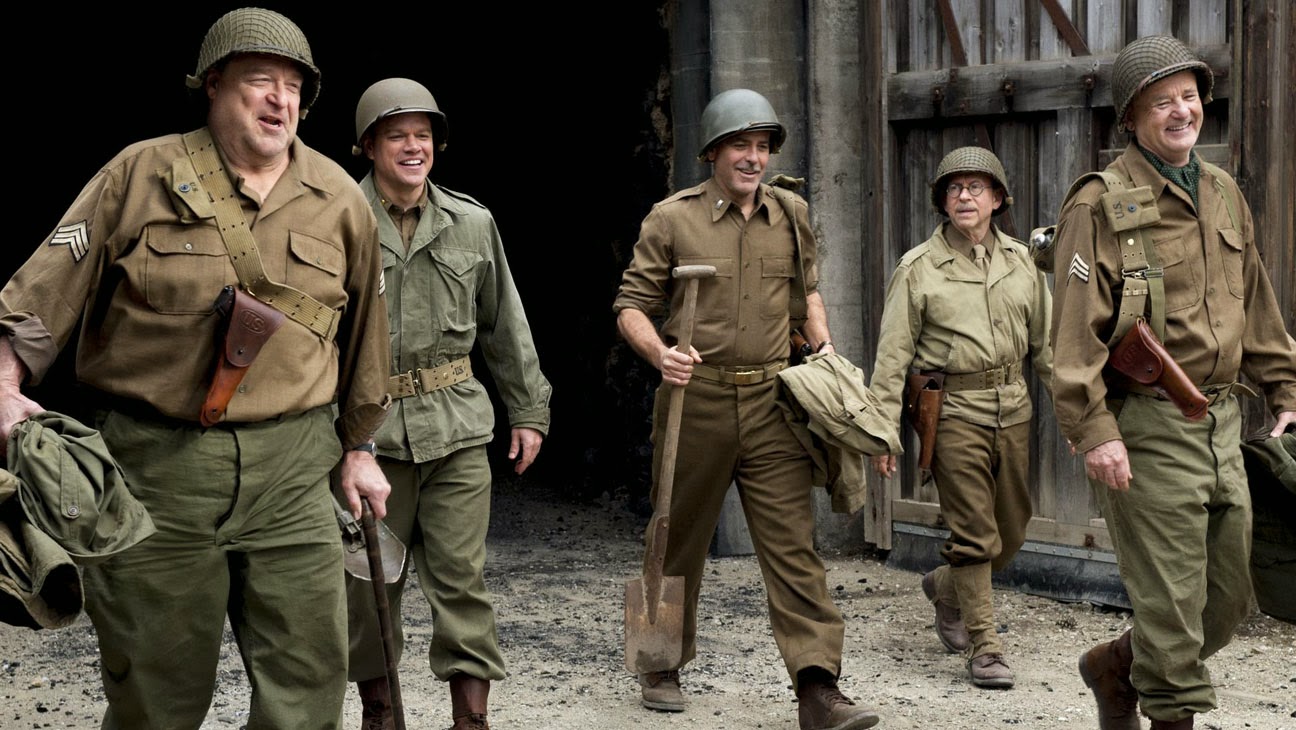
The Monuments Men fumbles many of its interior elements, including its stop-and-go pacing and fragmented plotlines, but what it gets right is rewarding enough to forgive many of its failures. The movie’s ultimate success is that it understands art on a profoundly deep level.

And not just knowledge of art — “here’s a Rembrandt, here’s a Monet, here’s a Renoir” — the film truly gets the concept of art and its importance to a civilization. In World War II, Hitler didn’t just want the world as a piece of real estate, he wanted every fiber, every micron of dust, every spinning electron. He wanted it all. That included all the art. “How do you erase a people? You not only kill them, but you erase their achievements,” someone says early in Monuments Men. After all, what is art but a collection of visualized hopes and dreams, fears and desires? Art isn’t canvas or marble or bronze, it’s an impassioned plea for immortality. Hitler, himself a failed artist, knew this and set out to sabotage it.

Pushing back are the Monuments Men, FDR’s super-team of art historians, dealers, architects, sculptors and painters. They’re captained by Frank Stokes (George Clooney), whose first order of business seems to be a movie montage as he recruits his team. I won’t bog you down with character names, because there are many, but the cast is top-notch: Bill Murray, Matt Damon, John Goodman, Jean Dujardin, Bob Balaban and Hugh Bonneville. Before they can go to Europe and save art, they have to go through basic training, which goes about as well as you would expect with this all-star team of actors. Murray shrugs over the obstacle course wall like a sack of potatoes. In a scene that drew big laughs, Goodman walks through a firing range not knowing the soldiers were using live rounds.

In Europe after D-Day, the Monuments Men quickly begin tracing down missing and stolen artwork, be it big museum pieces or smaller works ransacked from Jewish collectors’ homes. The Nazis used Paris, and much of Europe, like a shopping mall: they’d invade a country and top officials would pop in to get something to hang in their parlors. Several particular pieces get starring roles, including Michelangelo’s marble Madonna and Child, Rembrandt’s self-portrait, several pieces by Johannes Vermeer, and the striking Ghent altarpiece, a magnificent 15th-century painting on a set of elaborate shutters. The team is also tasked with telling Allied soldiers what they can and can’t bomb, which is punctuated by a sequence showing Italian villagers shoring up the walls of the bombed-out church housing Leonardo da Vinci’s The Last Supper. I looked this piece of history up after the movie; Monuments Men did not embellish how close the famous mural came to crumbling.

The narrative structure of the movie is put together sloppily. Scenes just sorta happen, often times with little leading up to them and little leading after. It all feels disjointed and frenzied. The acting is terrific, as is the insightful and historically relevant dialogue, and the individual scenes are spectacular, including one of Damon returning a painting to an empty apartment, its Jewish occupants long since carted off to gas chambers. But looking at the film as a whole, its scenes forming the film's central mass, it needs work. Having so many plotlines — the Madonna, the Ghent altarpiece, a weasely Nazi named Stahl and Cate Blanchett playing a museum record keeper — gave us too much to follow and, making matters worse, all the pieces were assembled with little regard to each other.

One other peculiarity, one that might have been intentional: no one really takes the war that serious. When they arrive in Europe, around D-Day+30, the Normandy beaches are mostly calm. As the team works its way inland, they rarely encounter any hostile Germans so it all feels rather tranquil and serene — just a couple armed guys out for a Sunday drive in matching outfits. Murray’s character wears an ascot under his soldier getup. Later he and Balaban encounter a German soldier and rather than starting a gunfight, they all sit down and have a cigarette. These two share another scene later when Balaban’s grumpy curmudgeon plays a record from the Murray characters’ grandkids. It’s tender and heartbreaking as a single sequence, but as a smaller piece of a bigger movie it rings hollow since the movie hasn’t established how violent and terrible the war was at that point. Men don’t cry and weep for their families when their safety has barely been threatened. Like I said earlier, though, some of this might have been intentional to punctuate two things: first, the deaths that do occur in the movie, and to show that these guys were not doing the heroic work of real soldiering. After all, they were there to save fabric stretched over wood frames, not save the world from a madman and his armies.

The Monuments Men is directed by Clooney, his fifth feature, and it’s not his sharpest achievement, although it's never dull. It needed more polish and a little more finesse with its script. This isn’t to say I disliked it; quite the contrary, I found the acting and subject matter to be riveting. I especially loved some of the payoff: great big caverns full of looted artwork, the reclaimed spoils of a terrible war. We've seen heroic survivor movies before, but here's one where the survivor is the culture of an entire continent.

(And here's some images of the real Monuments Men.)


Thursday, October 31, 2013

Slave drama chronicles shameful history

Movies are typically transient endeavors. They’re disposable little nuggets of entertainment that require nothing more than a seat, a dark room and an open set of eyes. They ask nothing of us but to sit, listen and watch. At a movie’s conclusion, we abandon the movie’s fading image on the screen, tip-toe over the scattered popcorn, walk to our cars and continue on with our lives.

Every now and again, we see a good one that we take home with us. We’ll laugh at its premise, or discuss the merits of its themes or plot. Or just admire its likable and pleasing stars.

Only rarely do we see movies that inform our views of the world, movies that cauterize into us the emotions of their players, movies that open our hearts and minds to a humanity we had not yet considered. These transcend the term “movie” to become part of our personal and cultural DNA.

Steve McQueen’s 12 Years a Slave is one of those rare movies. It does more than just dance light on a screen. It asks us to bear witness to America’s greatest shame, slavery, and also its greatest trait, hope. 

The movie is based on a book by Solomon Northup, a free-born black violin player in 1841. Solomon, played here by acting powerhouse Chiwetel Ejiofor, is a respected and well-spoken resident of Saratoga, N.Y., where he and his family have found kindness and equality in the pre-Civil War era. Solomon is invited to Washington, D.C., for a musical gig. When the job is over, he’s paid and taken to dinner, but he wakes up the next morning shackled in a basement within sight of the U.S. Capitol.

Solomon is sucked into a ruthless trade, one in which white businessmen kidnap and sell black men, women and children out of the northern states so they can be funneled down into the South, where slavery’s scourge is legal and thriving. In a grotesquely depressing sequence, Solomon and dozens of other kidnapped souls are held in a house that serves as a showroom for prospective buyers. The slaves are naked, and frequently slapped and poked, like your dad kicking that Buick's tires on the lot before the big purchase. White landowners come in and gaze at these terrified human beings as if they’re farm equipment — and essentially they are. One man can afford a woman, but not her child. Screams fill the house as the family is torn apart. “My sentimentality extends the length of a coin,” the slave trader tells her.

Eventually, Solomon ends up on the farm of a man named Ford (Benedict Cumberbatch), who treats his slaves with a semblance of dignity and respect. Unfortunately for the slaves, Ford is a busy man, so he delegates much of his farm’s oversight to Tibeats (Paul Dano), a vindictive and petty man who clearly just wants to see men bleed and suffer. The movie is full of these types, and I shudder to think of a third of this beautiful country pockmarked with gaping voids of hate and bigotry like Tibeats. To Dano’s credit, his character is so effective, he’ll make blood boil.

As the movie crawls forward — never flinching away from the whippings, beatings and hangings — we get a sense for what slave life must have been like: tedious, back-breaking work all day followed by quiet periods for meals and sleep late in the evening. Solomon spends much of his free time reflecting on his terrible circumstances — “I don’t want to survive. I want to live.” — and also plotting an escape that never materializes. He has many chances, but the plantation is big; the South is even bigger. He is told by others to not to let anyone know he can read and write, or they'll treat him suspiciously. The first chance gets he steals some paper to write a letter home; the only ink he has is blackberry juice.

The movie is directed by Steve McQueen, whose films (Hunger, Shame) offer stark, detached glimpses of terrible chapters in the lives of men. Even amid his large sets, the convincing period clothing and the era-appropriate dialogue, it’s obvious McQueen is a minimalist at heart. He doesn’t punctuate his scenes, or let them get too loud or flashy. They are shot simply, but effectively. Nowhere is this more obvious than on Ford’s farm: Solomon, a noose around his neck, is left hanging from a tree branch, his toes scraping the dirt just enough to keep him from choking to death. He hangs and hangs. The shadows change, indicating the passage of hours. Slaves wash and dry clothes behind him. Children play in the field. Birds chip. Cicadas buzz. And still he hangs, gasping for breath. It’s one of the most horrifying scenes in the movie, and yet it shows the very essence of McQueen’s work — understatement. It also helps that Ejiofor is so understanding of his character and the barbaric conditions he must suffer through.

Michael Fassbender, McQueen’s frequent muse, turns up late in the movie as the slave owner Epps, a monster even by Tibeats’ standards. On his farm, the beatings are more frequent, the whippings more savage and the conditions more degrading. Even Epps’ wife, a real peach of a woman, is some kind of twisted abomination. She lobs a decanter at a slave’s head so hard it nearly kills her. The audience I saw the film with recoiled so violently, the air seemed to be sucked out of the theater.

Several writers before me are calling 12 Years a Slave the Schindler’s List of slavery. I must agree. Steven Spielberg’s Holocaust film framed Nazi atrocities in a historical, but also emotional, context. It was shown in classrooms and aired unedited on television. It became a learning movie. To begin to understand what happened during the Holocaust, we had to witness its cruel awfulness. Riding similar principles, 12 Years a Slave might be the definitive movie about slavery. You simply must see it. Take your teens and, if they’re ready for it, your older children. We must not ignore this country’s great shame. We must confront it. And this movie bares its soul to history's ugly details. We've never seen slavery like this. Certainly television's Roots laid the foundation. (In many ways, Roots is to 12 Years a Slave what Shoah was to Schindler's List.) Django Unchained, for all its commentary about slavery, was not exactly historically accurate . 12 Years is going to be the first time you see some of these images, and you will wince and flinch.

Now, before I close, a word on two performances: Chiwetel Ejiofor and Lupita Nyong’o. Remember these names. We’ve seen Ejiofor before, in Children of Men, Salt and Love, Actually. He will win an Academy Award for this gripping portrayal of hope and survival. Nyong’o plays the character Patsey, whose story is representative of the slaves who didn’t escape. Because for every Solomon, there are thousands upon thousands of Patseys.


12 Years a Slave is one of the best movies of the year and, hand’s down, the most important. Go to the theater to witness it, but don’t treat it like a movie. It’s bigger and better than that. It’s the shame of this county’s past, but the hope of its future.


Tuesday, September 24, 2013

Feel the Rush: F1 history lesson impresses

In the disco era, there was nothing more rock ’n’ roll than a Formula 1 driver. They rolled out of bed, untangled their driving suit from their one night stand’s underwear, sped to the track, downed a shot, chased it with some champagne, puffed some weed and off they went in their little “coffin with wheels.” The patch on their driving suit reads, “Sex: Breakfast of Champions.”

Maybe they weren’t all like this in the mid-1970s, but James Hunt was a unique creature, especially in Ron Howard’s Rush, an incredible analysis of one of F1’s most epic racing feuds. The film is told from two points of view: one from British driver Hunt (Thor’s Chris Hemsworth) and the other from Austrian virtuoso Niki Lauda (Daniel Brühl). Other than being fantastic drivers, the two couldn’t be more different. Hunt, handsome and charming, walked around the pits without his shoes on. Lauda, exacting and talented, probably slept in his. The Austrian orbited around an all-consuming singularity — winning. Hunt’s motivation was simpler: defeating Lauda.

One of the more rewarding aspects of Rush is how Howard treats these two figures — the charismatic Hunt, and Lauda, dubbed “King Rat” by the other drivers — with such gentle compassion and careful framing. He likes them both, and it shows in their separate sequences, as well as in the kinetic racing scenes they share. A shrink could write psychological profiles on audience members’ favoring of one driver over the other. “So you like Hunt, which means you are wild and passionate, capable of throwing the rules out the window and flying by the seat of your pants.” Or, “You identify with Lauda because you don’t care what people think about you and you feel that caution and restraint are admirable qualities.” The movie is a litmus test for your own attitudes about competition and winning.

It’s also an engrossing story. It begins in Formula 3, where Hunt and Lauda begin their rivalry. Hunt seems to thrive by instinct alone; Lauda by knowing his engine and knowing the tracks he’s racing on. They immediately dislike each other, which is magnified exponentially when Lauda buys his way onto a Formula 1 team. “You can do that!?” Hunt groans to his team. Before long, Hunt’s on his own Formula 1 team and the rivalry continues.

Lauda is the better driver, but Hunt has style; if Lauda plays classical, then Hunt plays jazz. Their opposing methods are clearly evident at the German Grand Prix, a beastly 14-mile track called the Nürburgring, which sounds like someplace very evil in a J.R.R. Tolkien book. “A place of shadow,” Gandalf would say. Lauda protests the race citing weather concerns, but the other drivers think it’s a ruse to cut a race from a season that Lauda is likely to win. They all balk at his protest and the race continues amid dangerous conditions. Midway through the race, Lauda is in a nasty accident that nearly kills him. His car spins out and hits a wall, trapping him inside leaping gas-fed flames. You can YouTube the real footage of this crash, but it’s terrifying. The Rush version is only slightly less grisly, if only because that’s an actor and pyrotechnics and not a real human being inhaling fire as he fights seat restraints.

I’m giving away too much of the movie, but if you’re still reading this, it’s likely you’re a F1 fan and already know what happens. Lauda goes through an intense (and abbreviated) recuperation, while Hunt goes on and wins a bunch of races. In the end, it all comes down to the Japanese Grand Prix at the base of Mt. Fuji, where Hunt and Lauda will have to duke it out in the last race of the season. I will let you discover how it ends.

The technically proficient Howard, who reinvented fire for Backdraft and space movies for Apollo 13, does little for racing cinematography in the first half of Rush. The shots, while thrilling and lively, don’t reinvent driving or race cars, not like John Frankenheimer’s Grand Prix did in 1966. Many of the shots involve static setups of cars careening around corners, or blurry side-by-side shots of F1 cars zipping down tracks. In a word, the races are bland. They do get much better, though, especially during the pivotal Nürburgring and Fuji races, which are exhilarating exhibitions of speed and drama. Howard and screenwriter Peter Morgan (Frost/Nixon) imbue the film with so much F1 trivia and authenticity that you’ll start to appreciate why Howard was on the starting grid at every F1 race for nearly two seasons — he was proud of the film he was working on. Current F1 fans will appreciate the name dropping and vintage cars, including that wacky six-wheeled Tyrrell car.

Better yet are the performances by Hemsworth and Brühl, who rise to the challenge of playing these complicated men with their dangerous hobbies. Now that he’s been Marvelized as Thor, I forget that Hemsworth can really act. And terrifically, too. He has a toe-tapping montage set to the Spencer Davis Group’s hit “Gimme Some Lovin’” and a sequence where we see his method of memorizing every turn and gear shift of a track. The wonderful Olivia Wilde has a small thankless role as his wife, who can't sustain him in his wreckless phases so she jets off to have an affair with Richard Burton. Brühl, who most will remember as the Nazi sniper and propaganda poster boy from Inglourious Basterds, is something to behold here. He has a scene set in the Italian countryside that is just splendid. It begins when a pair of Italian Ferrari fans (Lauda drove for Ferrari at the time) insist he drive their car after his breaks down. They sit in the back of their own car grinning like fools as Lauda pilots the jalopy around hairpin turns and up country hills. 

This is an incredible picture, but my only concern for Rush is that people won’t see it. It happened with Cinderella Man, Howard’s 2005 Depression-era boxing movie. It was a great movie, but it didn’t have an audience. After several miserable box office weekends, the studio told theaters to start issuing refunds to customers who didn’t like the film. The idea was that it would get butts in the seats, and then they were unlikely to ask for a refund because, after all, Cinderella Man was a fantastic movie. I’m very curious who the audience is for Rush. Formula 1’s largest audience is not in the United States, which largely prefers NASCAR and light beer over F1’s more challenging style of racing.


My hope is that non-racing fans discover the movie for its complex character studies, solid story and authentic setting. And if you like racing, well, then there’s a bit of racing here, too. Just a smidge.