Showing posts with label War. Show all posts

Sunday, October 18, 2015

Like a bridge over troubled water

In the 1950s Americans lost their collective minds looking for communists. Many innocent people were caught up in the “red scare” and Joseph McCarthy’s televised witch hunt. Steven Spielberg’s Bridge of Spies is not about one of the innocent victims of the era, but an actual communist, a spy sent from the Soviet Union to steal American secrets in the event of — gulp — nuclear armageddon.

The Cold War does not have the sweeping appeal of World War II, with its tanks and soldiers blasting away at each other on panoramic battlefields, but it’s stories are just as revealing about the soaring heights (and plunging depths) of humanity, and the morality of a silent warfare that turned American against American.

In 1957, the United States government reached out to attorney James Donovan (Tom Hanks), an insurance lawyer in Brooklyn. They asked him to take the case of Rudolf Abel (Mark Rylance), a KGB infiltrator caught spying for the Soviets. They have Abel dead to rights, but they need a talented lawyer to defend him rigorously to keep up appearances that, indeed, America is a bastion of democratic, constitutionally sound values and principles. Donovan agrees and is quickly stonewalled by a biased judges, a kangaroo court, an overzealous prosecuting attorney and a pitchfork-wielding public that sees commies in its soup.

Presented as a legal procedural, the early segments of Bridge of Spies are expertly choreographed and fascinatingly presented. Here’s Donovan, doing Uncle Sam a favor, being spied on by Uncle Sam. Hanks, at his most feisty, has a great sequence with a CIA agent, who asks Donovan to violate attorney-client privilege by revealing what Abel actually did for the Soviets. The lawyer bristles at the request, and pounces. “Don’t nod at me and smile you son of a bitch,” Donovan tells the American spy. It’s wickedly fun, and Hanks hits all the right notes to get the audience on Donovan’s side, regardless of what his client has been accused.

In a concurrent sequence of events, four young pilots are being briefed on a new mission, one that will take them 70,000 feet up over Soviet Russia in a U2 spy plane. Gary Powers (Austin Stowell) is one of the pilots, and on his first flight encounters the loving embrace of Mother Russia. Powers and Abel quickly find themselves as pawns in a political game of chess that has global stakes. The players in the game are proxies, stand-ins who don’t have official status: for the Soviets it’s several communist-friendly power players, and for the Americans it’s Donovan, a pudgy Brooklyn insurance attorney whose wife thinks he’s fishing in England.

If you know history, you know what happens next, and it’s fascinating stuff, particularly when Donovan heads to East Germany to negotiate with his counterparts on the other side of the still-forming Berlin Wall. These scenes on the other side of the Iron Curtain are photographed in gloom, with cold colors and chilly concrete. The setting must have felt hopeless for Donovan, who’s robbed by a street gang, jailed by border guards and tactically outmaneuvered by an array of communist bureaucrats with conflicting of agendas.

Spielberg is known for his big movies — Raiders, Jaws, Saving Private Ryan — but I would argue that his smaller character-driven pictures show just as much mastery of the medium as the blockbusters. Here he tells a story about a man fighting for American ideals that America itself doesn't want to be bothered with. Hanks is terrific — when is he not? Rylance as the Soviet spy Abel is especially electric. He has a refrain that appears frequently, “Will that help?” You don’t seem worried about the death penalty, Donovan tells him in court. “Will that help?” Abel is a curious character, one that Rylance wraps in mystery and self sacrifice. Few actors can keep pace with Hanks, but Rylance does, and with apparent ease.

Mostly, though, Bridge of Spies is a collection of tiny victories: the lighting is nuanced and effective, the camera work is modestly unassuming, the sets and locations invoke the paranoia of the time and place, and the small details of East German life, such as an indoor hallway for bicycle messengers, gives the film its unique cinematic identity.

Spielberg makes too few movies, and it’s movies like Bridge of Spies that makes me yearn for more.

Thursday, October 16, 2014

The Sound and the Fury

Fury plays fast and loose with its military action, but never with its stars — the tanks. 

The metal goliaths, featured heavily in David Ayer's World War II epic, crunch into battle at a tedious pace and with the subtlety of, well, a smoke-belching tank. "Over there," a soldier says pointing at a treeline, and off the tank goes to blast the bushes into yard mulch. The tanks turn and chug toward danger because that's what they were designed to do — battering rams, roadblocks and troop shields. It does not make for the most plausible, nor exciting, action sequences. More on that later. 

The film follows a tank crew during the final push through Germany before the fall of the Third Reich. It's April 1945, weeks away from Hitler's suicide, when the German people, including women and children, were told to defend the country until the very end. The tank, called Fury, is captained by Wardaddy (Brad Pitt), a battle-hardened Nazi-killer with a cool temperament. His crew includes Bible (Shia LaBeouf), Gordo (Michael Peña) and Grady (Joe Bernthal), and they are crudely jaded by war and its atrocities. They make the soldiers from Samuel Fuller's The Big Red One look like Sunday School teachers. 

The film shepherds us into the war with a surrogate, the fresh-faced teen Norman Ellison (Logan Lerman), who has been assigned to Fury from a cushy position at headquarters. "I type 60 words a minute. I'm not meant to be here," he pleads with the tank and its crew. Norman is given a position at the front of the tank, where he operates a machine gun turret next to the driver. When it's safe to do so he pops his head out of a hatch and gets a nice view as the tank bops down the German countryside. During a firefight, he drops down under the hatch and uses a nifty periscope to (barely) see what, or who, he's shooting at. 

Ayer's film, which he also wrote, establishes one principle very early on: the tanks, even with their armor plating, are fragile monsters. One wayward bullet and gas ignites, shells explode and the tank turns into a convection oven. Then, of course, there are German bazooka teams, landmines and the nearly impenetrable tiger tank, a feared enemy by any Allied soldier. It's amazing any of these brave tank crews survived the war. Making things more hazardous is the way the tanks fight in Fury's battles: when meeting the enemy, tanks turn and grumble into the action in a straight line. While dog-faced infantrymen use cover, weave through the trees and generally try to use a tactical approach, the tanks just drive right in, which makes for anti-climactic action sequences. Maybe this is the way the real tank battles were fought, in which case the film nailed it, but I couldn’t help but think of Civil War movies and the frustrating tactics that those soldiers used. Marching into bullets in spiffy rows of targets likely got a lot of men killed. I can't imagine that strategy, even with tanks, would ever be suggested. Someone flip through a Stephen Ambrose book to check.

This tactical curiosity is clearly seen in one sequence where a column of tanks face off against a single tiger tank. The Americans turn to engage and then chug forward as the German foe obliterates one metal beast after another. Was there not another way to fight this battle? The ease at which these tanks are destroyed directly contradicts with the logic of the last sequence, which features a single tank — without treads, low on ammo and exposed — decimating an entire company of elite SS. Either the tanks are paper-thin shooting targets or indestructible bullet sponges, but not both.

I will say this, though, the tanks looks amazing. A lot of work went into their creation, and they are convincing creatures unto themselves. Especially noteworthy are the shell effects, with high-velocity tank shells ricocheting off hulls, bouncing off soggy soil and piercing armor in perfectly round holes. The threat of a tank barrel pointed at the screen felt real, with terrifying consequences. The same can't be said about the regular bullets, which only found American flesh when the plot demanded it. Germans were apparently awful shots or crack shots, but never a mixture of both. The movie doesn't treat all hand grenades equal either: American hand grenades had quick fuses that exploded on contact, yet German grenades were so slow to blow up that Americans could snatch them up and heave them back. Was this a real difference between the two armies, or was Ayer’s script skewed for its heroes? I'm dissecting war clichés here, but they're so dreadfully obvious I feel compelled to bring it up.

Forgiving the munitions, Fury dwells mostly on the main tank and its ultimate destiny at a German crossroads, but the film isn't shy about turning its attention on the tank's human controllers, be it Gordo and his Mexican heritage or Grady and his backwoods mumble. One noteworthy performance is by LaBeouf, fresh off his crazy tour, as a Bible-thumping creepo. He initiates one of the more interesting conversations in the movie: if anyone can be "saved" by Jesus' grace then couldn't Hitler be saved? He's truly stumped. 

The central characters are Wardaddy and Norman, playing master and apprentice. Pitt's Southern snarl is lewd and nasty, but he imbues the character with a gritty affection. "Wait til you see it … what a man can do to another man," Wardaddy, the Davey Crockett to the tank's rolling Alamo, says to Norman. "Ideals are peaceful. History is violent," he adds later. These two characters take Fury on a hard left turn as they wander through an apartment complex and meet two German women. Tension fills the room as Wardaddy removes his clothes and makes glances toward a bedroom. But the scene didn't go where I thought it would, and it instead revealed a great deal about Fury's heroes. Although the scene is a dramatic detour, one I greatly enjoyed, it does not knock the tracks off the movie's momentum. 

The photography is, at times, exceptional, including several scenes that are worthy of commendation: a formation of bombers weaving a metal carpet in the sky, shots of Americans playing baseball with stack of worthless German money, and a stunning opening shot of a German on horseback riding through the mists of war, the battle-churned mud, and the pierced and smoldering carcasses of beetles with names like Panzer, Tiger and Sherman. This can be a gorgeously ugly movie. 

Fury isn’t the greatest World War II movie, but it is a noteworthy one, despite its sluggish depiction of tank warfare. It proves that there are still many stories worth telling from a 70-year-old war. 


Friday, June 27, 2014

Faces and trigger fingers are stars in Korengal

What we don’t understand about battle-born PTSD isn’t that troops want out of the war zone, but they want back in. 

That is one of many interesting new insights in Korengal, the sequel and follow-up to the award-winning Restrepo, which featured a platoon of soldiers in Afghanistan’s deadly Korengal Valley, where gorgeous scenery concealed hundreds of enemy combatants and the daily hell they brought to American troops. 

Restrepo is the name of the sandbagged outpost perched high up on a mountain in Korengal. It’s named after a soldier who was killed there. The way the soldiers talk about their mountain fortress has an Apocalypse Now tint to it. Restrepo is their Kurtz compound. But instead of a long ponderous journey up a river to get there, they’re airlifted there in a day. There’s no acclimation. One day they’re somewhere safe; the next they’re in the maw of the mountain, a death zone that will torment them throughout their 15-month tour. 

And yet, when the soldiers talk about it, Restrepo is their home. They feed off the danger, the rush of firing that massive 50-caliber machine gun, the crack of bullets over their head, the solidarity of their weary band of brothers. Sebastian Junger’s documentary benefits because it doesn’t have to say anything; it lets the soldiers speak. And we have the opportunity to listen. 

Of course, it helps if you’ve seen Restrepo, though that’s certainly not mandatory. Some of the footage will look alike; Korengal is essentially B-roll from the earlier movie. But where Restrepo was more about the perils of war, this movie is more ponderous and concerned with the details of the day-to-day living and fighting. Korengal Valley is home to an Al Qaeda highway, but it “looks like Colorado Springs,” one soldier says. He walks us through the nicknames of some of the pre-sighted hills — Spartan Spur, Nipple Rock, Honcho Hill. Personalities start to come out heavier. One soldier romanticizes his machine gun in a way only other soldiers will relate to. 

The troops confirm something that Americans might be unsettled by: they love the firefights. Injuries and deaths were always awful, but the occasional skirmish lets them blow some steam off. And their weapons become extensions of their souls, screaming to release. One man is asked what he’s going to miss. “Shooting people,” he says.

The firefights serve an important purpose beyond their obvious catharsis — they are proof the enemy is still there. Silence and boredom can wage wars of attrition in Korengal. On slow days, the troops lounge around, the weight of the world grinding against them. If only they had something to shoot, or kill, or blow up. When the enemy doesn’t come to them, they go to the enemy on patrols to nearby villages, where villagers greet them. “That guy accepts our 10-pound bag of rice during the day. Fires RPGs at us at night. And then the next day he smiles and waves. Fuck his heart. Fuck his mind,” a soldier says, quoting LBJ’s mission in Vietnam to win “hearts and minds.”

The movie has some absurd imagery right out of a Joseph Heller novel: soldiers firing their machine guns wearing only their military-issued boxer shorts, soldiers playfully holding hands on a patrol, and a scene of a troop smashing his guitar at Restrepo so it can’t be played anywhere else. War might be hell, but it’s also surreal and strange. 

Junger filmed Korengal and Restrepo with photojournalist Tim Hetherington, who was later killed while covering the Arab Spring in Libya. His camera work is exceptional because he focuses on what matters most — faces. It’s a personal touch from which the movie benefits greatly.

Korengal might be a slight rehash of Restrepo, but it gives us another chance to listen to soldiers tell us their stories. We should never stop listening.

Thursday, June 5, 2014

Up, up, down, down, left, right, left, right

If The Edge of Tomorrow were just the sum of its parts — its internal mechanisms being Saving Private Ryan, Groundhog Day and War of the Worlds — then it would be a perfectly acceptable action blockbuster. But the film excels past its formula, soaring into the lower tiers of sci-fi greatness.

At the center of Edge of Tomorrow’s mech-suited bombast is Tom Cruise, who — no surprise, here — knows his way around a bonanza of futurist ideas and concepts. Few actors seem very interested in experimenting with science fiction, but Cruise is fearless at the genre, from Steven Spielberg’s one-two punch of Minority Report and War of Worlds, to last year’s fascinatingly ambitious, though hammy, Oblivion. Here, in Edge of Tomorrow, Cruise plays Cage, a PR flack for the United States military. The opening moments show us a Starship Troopers-like flip-through of cable news, where we learn that an alien race has hijacked a comet and crash landed in Europe to breed like a bacteria. And there’s Cage, grinning like only a public relations geek can, as he analyzes the alien invasion with Wolf Blitzer.

In a slithery little PR move that reeks of bureaucracy, Cage is sent to the front lines of the alien invasion, where he’s fatally mangled during a gruesome D-Day-inspired beach-storming that turns out to be an ambush devilishly orchestrated by the sinewy tentacle-strewn aliens. But Cage doesn’t die, at least not permanently. He wakes up in the previous day, and only he’s aware of it. It’s as if the world reset back 24 hours just for him. This is where Tomorrow’s intricate construction begins to shine: now in the second version of the same day, Cage makes tiny changes to his original delivery, which reveals different outcomes and permutations to the events of a day he’s already lived (and died) through. A complacent Cage yields one scenario, while an ambitious Cage gets another one entirely. Those familiar with Groundhog Day and Bill Murray’s oft-repeated routine — “I Got You Babe,” coffee in the lobby, Needlenose Ned, Punxsutawney Phil — will find Tomorrow’s version of the same concept to be a riot, including when Cage tirelessly attempts different stunts through several weeks worth of catastrophic deaths. I especially enjoyed Bill Paxton, playing a commanding officer, who is often perplexed at Cage’s apparent clairvoyance.

The finale to each of Cage’s days is the European invasion, which he can never survive — like a difficult video game level, but with unlimited lives. He’s crushed, impaled, shot, blown up, drowned, set on fire, eaten, chewed up, ground into a chunky paste … death knows no bounds as he re-lives the same day over and over again. He eventually teams up with Rita (Emily Blunt), who had her own never-ending day a couple months before. She relived her day for so long that she eventually became a badass super soldier that earned her the nickname Full Metal Bitch. But her day ended, and now she latches onto Cage to try to crack this alien enemy, which uses time travel and forever-days as a tactic to refine their strategy. When she realizes he’s in the middle of one of the déjà-vu days, she tells him to “find me when you wake up,” and then promptly shoots him, starting another rebooted sequence. Later, they hunker down over topographical maps and sketch out their plan of attack; after each failure they make new annotations to their notes (right turn here, pause, run forward, back up, left). The maps get quite cluttered.
Edge of Tomorrow works so well because its inventive with its concepts. I especially appreciated how the script assumed we would understand the material. When Cage finds Rita for the first time, he doesn’t have to spend 30 minutes convincing her. She knows what he’s going through, and the film doesn't torture us with his long explanation of it to her. And like Bill Murray’s weatherman in Groundhog Day, Cage dramatically goes through all the stages of grief as he wanders through the same day over and over again, whether its months or 10,000 years. The first week is spent in denial, trying desperately to win the invasion. Then he goes through anger and a nasty bout of depression, including when he lets a fellow soldier get repeatedly squished by a falling deployment chopper. And then comes acceptance, where the film kicks into overdrive as Cage finally learns how to crack the day. This isn’t as philosophical or spiritual as Groundhog Day, but it has its charms. 

It also has its special effects, which are abundant and cleverly used. The big one is the mechanized suits worn by the soldiers. These hydraulic war costumes — kinky lingerie for cyborgs — seem too clunky and silly to wear into battle, but the plot builds much of every action scene around their overpowering ferocity. Although, Rita’s suit brings up a point I last brought up on the first Transformers movie: why would someone use a sword when they’re body is essentially one big gun? The other big special effect is the aliens, who move so quickly they’re hard to see until later in the movie. They achieve locomotion by spinning their squid-like arms around and rolling forward, like dust bunnies or tumbleweeds. They’re rather terrifying, with jump scares to prove it, but they’re generally harmless, if only because no one really stays dead in the movie.

Edge of Tomorrow is a fascinating and remarkably well-equipped science fiction film, one that allows Cruise to shine in a genre he has cornered for himself. The action and special effects are largely impressive, but the core science-fantasy mechanic bundles everything up nicely. That and the subtle chemistry of Cruise and Blunt, the latter of which is more than capable as an action heroine. It also embodies all that a summer movie should be: action, drama, romance, comedy, special effects, as well as some lesser-known pieces, like invention, wit, mystery and some light philosophy. It’s doesn’t overdo or neglect any one element. It just finds a nice balance for all of it, and then snaps it all together in what might be the most worthwhile blockbuster of the summer. 


Thursday, February 6, 2014

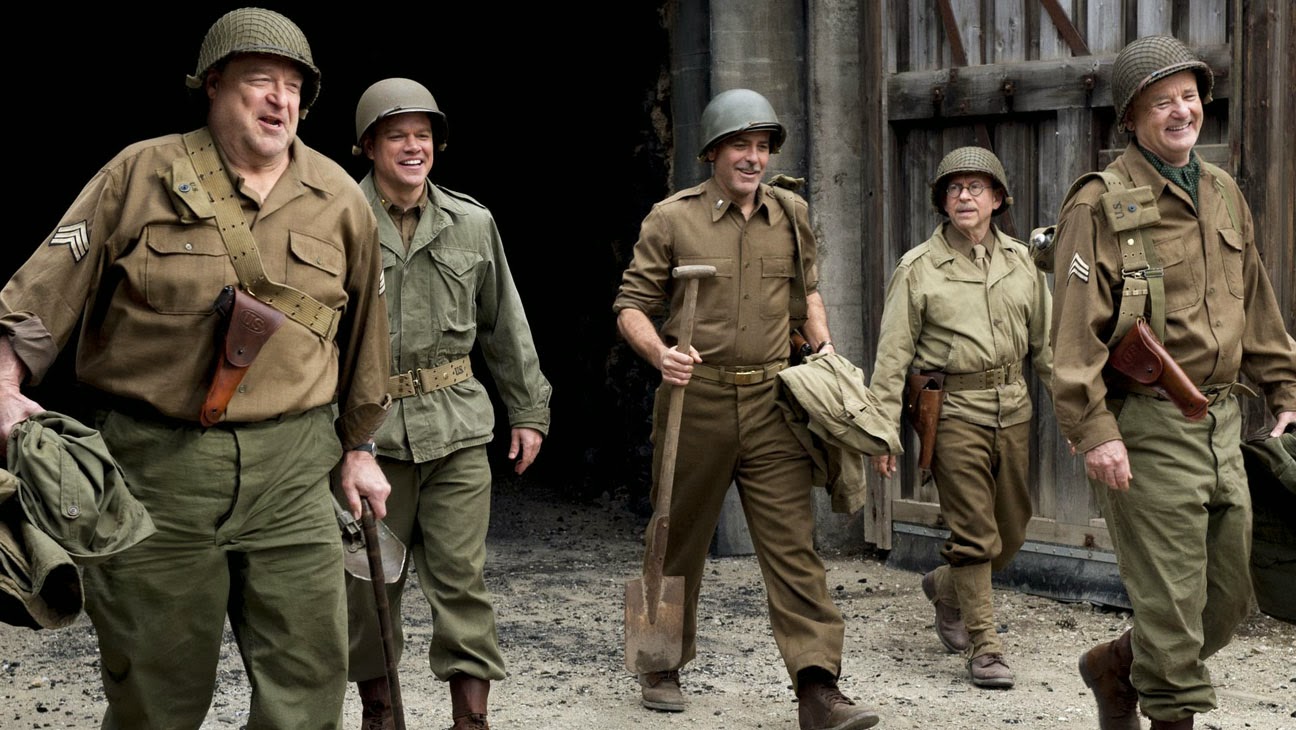
Monuments Men no work of art, but that's OK

The Monuments Men fumbles many of its interior elements, including its stop-and-go pacing and fragmented plotlines, but what it gets right is rewarding enough to forgive many of its failures. The movie’s ultimate success is that it understands art on a profoundly deep level.

And not just knowledge of art — “here’s a Rembrandt, here’s a Monet, here’s a Renoir” — the film truly gets the concept of art and its importance to a civilization. In World War II, Hitler didn’t just want the world as a piece of real estate, he wanted every fiber, every micron of dust, every spinning electron. He wanted it all. That included all the art. “How do you erase a people? You not only kill them, but you erase their achievements,” someone says early in Monuments Men. After all, what is art but a collection of visualized hopes and dreams, fears and desires? Art isn’t canvas or marble or bronze, it’s an impassioned plea for immortality. Hitler, himself a failed artist, knew this and set out to sabotage it.

Pushing back are the Monuments Men, FDR’s super-team of art historians, dealers, architects, sculptors and painters. They’re captained by Frank Stokes (George Clooney), whose first order of business seems to be a movie montage as he recruits his team. I won’t bog you down with character names, because there are many, but the cast is top-notch: Bill Murray, Matt Damon, John Goodman, Jean Dujardin, Bob Balaban and Hugh Bonneville. Before they can go to Europe and save art, they have to go through basic training, which goes about as well as you would expect with this all-star team of actors. Murray shrugs over the obstacle course wall like a sack of potatoes. In a scene that drew big laughs, Goodman walks through a firing range not knowing the soldiers were using live rounds.

In Europe after D-Day, the Monuments Men quickly begin tracing down missing and stolen artwork, be it big museum pieces or smaller works ransacked from Jewish collectors’ homes. The Nazis used Paris, and much of Europe, like a shopping mall: they’d invade a country and top officials would pop in to get something to hang in their parlors. Several particular pieces get starring roles, including Michelangelo’s marble Madonna and Child, Rembrandt’s self-portrait, several pieces by Johannes Vermeer, and the striking Ghent altarpiece, a magnificent 15th-century painting on a set of elaborate shutters. The team is also tasked with telling Allied soldiers what they can and can’t bomb, which is punctuated by a sequence showing Italian villagers shoring up the walls of the bombed-out church housing Leonardo da Vinci’s The Last Supper. I looked this piece of history up after the movie; Monuments Men did not embellish how close the famous mural came to crumbling.

The narrative structure of the movie is put together sloppily. Scenes just sorta happen, often times with little leading up to them and little leading after. It all feels disjointed and frenzied. The acting is terrific, as is the insightful and historically relevant dialogue, and the individual scenes are spectacular, including one of Damon returning a painting to an empty apartment, its Jewish occupants long since carted off to gas chambers. But looking at the film as a whole, its scenes forming the film's central mass, it needs work. Having so many plotlines — the Madonna, the Ghent altarpiece, a weasely Nazi named Stahl and Cate Blanchett playing a museum record keeper — gave us too much to follow and, making matters worse, all the pieces were assembled with little regard to each other.

One other peculiarity, one that might have been intentional: no one really takes the war that serious. When they arrive in Europe, around D-Day+30, the Normandy beaches are mostly calm. As the team works its way inland, they rarely encounter any hostile Germans so it all feels rather tranquil and serene — just a couple armed guys out for a Sunday drive in matching outfits. Murray’s character wears an ascot under his soldier getup. Later he and Balaban encounter a German soldier and rather than starting a gunfight, they all sit down and have a cigarette. These two share another scene later when Balaban’s grumpy curmudgeon plays a record from the Murray characters’ grandkids. It’s tender and heartbreaking as a single sequence, but as a smaller piece of a bigger movie it rings hollow since the movie hasn’t established how violent and terrible the war was at that point. Men don’t cry and weep for their families when their safety has barely been threatened. Like I said earlier, though, some of this might have been intentional to punctuate two things: first, the deaths that do occur in the movie, and to show that these guys were not doing the heroic work of real soldiering. After all, they were there to save fabric stretched over wood frames, not save the world from a madman and his armies.

The Monuments Men is directed by Clooney, his fifth feature, and it’s not his sharpest achievement, although it's never dull. It needed more polish and a little more finesse with its script. This isn’t to say I disliked it; quite the contrary, I found the acting and subject matter to be riveting. I especially loved some of the payoff: great big caverns full of looted artwork, the reclaimed spoils of a terrible war. We've seen heroic survivor movies before, but here's one where the survivor is the culture of an entire continent.

(And here's some images of the real Monuments Men.)


Wednesday, January 8, 2014

Lone Survivor: Fire on the Mountain

How does a director go from Battleship, one of the most reviled military thrillers of recent memory, to Lone Survivor, a very personal movie about real American soldiers who fought and died in Afghanistan?

For Peter Berg, the director of both, the answer is this: very carefully.

If you're familiar with Berg and his directing style — picture manic swearing screamed from a belligerent child strapped to the front of a battering ram — then you'll know why his careful handling of Marcus Luttrell's 2007 book comes as a surprise to me. Berg was cast in the shadow of more technical directors (James Cameron), more endearing ones (Ron Howard) and more bombastic ones (Michael Bay), and aside from the poignant Friday Night Lights, his catalog is filled with dud (The Rundown) after dud (Hancock) after dud (The Kingdom). Somehow, though, the actor-director pulls this one together with the kind of skill and wizardry of some of Hollywood's best. 

Lone Survivor strikes the right note right out the gate. It opens on documentary footage of Navy SEALs going through their BUD/S training. If you'll recall Ridley Scott's G.I. Jane, BUD/S, or Basic Underwater Demolition/SEAL, is the hellacious training that Demi Moore's character suffers through to prove herself. In this footage, though, we're not seeing actors, but real faces. They beam with potential. These faces will return; more on that later.

The film picks up with Michael Murphy (Taylor Kitsch) assembling his SEAL team — Marcus Luttrell (Mark Wahlberg), Danny Dietz (Emile Hirsch) and Matt Axelson (Ben Foster) — to get choppered into a valley deep in Afghanistan to pour some mayhem down on a terrorist target. These are some bad mo-fos, with their beards and their swagger. To quote Zero Dark Thirty: "… you guys with your dip and Velcro and all your gear bullshit." A fantastic early sequence has one of the "rootin' tootin' shootin' paratroopin'" newbies reciting a SEAL poem that is as charming as it is vulgar.

Musically held together not by pop music or blaring rock 'n' roll, Lone Survivor is scored in part by post-rock instrumentalist outfit Explosions in the Sky, and the band's floaty free-form guitar concepts hypnotize the early sequences into a cerebral meditation on service and the cohesion that exists with these elite warriors. By the time the four SEALs are initiating the beginning phases of Operation Red Wing, we're pretty much ready for that "everything is going to be OK" illusion to be shattered. And it certainly does when the soldiers are faced with a moral dilemma that they pass with flying colors, even if it means their lives are forfeit. 

What happens next is the least interesting part of the movie, but one that will likely thrill most action junkies: the four SEALs are boxed into a guns-blazing battle with dozens of enemy fighters. The gunplay is intense and violent, much of it to due to the action's stark presentation and the realistic weaponry. Guns have powerful calls, and bullets have devastating responses. (But the RPGs seem to have no negative repercussions, even as they burst next to exposed faces.) With superior training and firepower, the four soldiers push the enemy back with extreme precision. And even as bullets skid past (and through) them, they shake it off and hold their corners. Remember when Jesse Ventura said he "ain't got time to bleed" in Predator? That was a paper cut compared to these wounds, including one that is gaping so wide that medical treatment involves packing it with soil. At one point, the SEALs are backed up against a cliff, and they make a choice that requires a level of commitment that is beyond comprehension — they jump off. Their bodies ragdoll down the rock face, tumbling over boulders and through trees. The sequence is so effective you're better off watching it from behind your fingers. 

The four cast members are often hidden behind their beards and rifle scopes, but they depict their subjects with honor and valor, neither deifying their bravery or downplaying their heroism. They're played like average guys, guys you'd want to get a drink with and watch a football game with. They were doing their jobs partly for their country, but mostly for each other; Uncle Sam is an idea, but Marcus, Mike, Danny and Axe are real people stuck in the shit together. I only hope that audiences recognize these guys as brothers before action heroes. 

That being said, Lone Survivor is a competent and agile movie that does justice to its four central heroes. And best of all, Berg ends the movie the way he started it — with the faces of the real SEALs. It's the most important part of the picture, and I'm glad Berg lets the images linger on the screen. We need to see those faces, and remember them.