 World War II has been covered so extensively on film by so many gifted directors — and some hacks — that any true originality in the genre was mined long ago. Quentin Tarantino found a way around all the worn plots with this audacious strategy in his intentionally misspelled Inglourious Basterds: he wrote his own version of the war.
 That’s right, he just made stuff up. That should be sacrilege to history, especially since WWII is hallowed ground even 60-plus years after its end. But Tarantino gets away with it — he gets away with everything — because his film provides a catharsis that the war itself could not provide. In his version of events, the war ends after a rag-tag group of Jewish Americans stage a mass execution of German high command in a little French movie theater. Film buffs should have fun with that movie theater part. Only Tarantino, a noted film buff, could stage a gunfight in a projection booth. Only Tarantino could kill Hitler with in an inferno fueled by nitrate film stock. Only Tarantino would have a movie critic parachute into Nazi-occupied Europe to help end the war.
Full of likeable every-guy heroes, menacing German villains, seductive femme fatales, fully-dressed locations and sets, exquisite costumes of square-shouldered Gestapo overcoats and tatty American tank tops and fatigues, and a variety of languages (German, French, Italian, English), Inglourious Basterds is, for the most part, your run-of-the-mill World War II movie. But Tarantino filters the story through his movie-loving brain to produce this mish-mash of cocaine-induced hyper-stylized film homages. The title may refer to its heroes, a troop of vigilante soldiers who have no higher command to answer to, but it also refers to the bastardization of other film genres to tell its story.
 It’s been widely reported that Tarantino wanted to merge a classic war movie with an epic Spaghetti Western. At one point the film was going to be called Once Upon a Time in Nazi-Occupied France, an allusion to the famous cowboy opera by Sergio Leone, an obvious influence here. Remarkably, almost inexplicably, QT accomplishes this Frankenstein-like assembly and then gives it the juice it needs to stomp through Kraut-occupied France in one of the most daring films of the year. Daring because you must adopt a new WWII history and also because impatient Tarantino fans will likely be challenged as the dialogue proves to be painstakingly, yet pleasantly, prosperous and the violence is shortlived, albeit quite gory when it does finally turn up in a head-smashing homerun derby.
The first scene could easily be right from a Leone film: a French farmer hosts an unannounced SS officer during his search for Jews in the countryside. They talk slowly, carefully. The Nazi is given milk. They smoke from pipes. The tension builds. They’re playing chess with their dialogue. A couple minutes stretches into a dozen. The officer is smart. The farmer is trapped. By the time the Nazi asks, “Are you hiding Jews in this house?” the man has tears streaming down his face. Like Leone, Tarantino allows dialogue to serve as suspense.
 Not all of the dialogue is as flowery, though. Consider Aldo Raine (Brad Pitt), the leader of the Basterds, a group of American troopers sent into France to scalp Nazis first and ask questions … well, never. Raine talks like he learned English from a drill instructor: “You probably heard we ain’t in the prisoner-takin’ business. We in the killin’ Nazi business. And cousin, business is a-boomin’.” Each word is nearly grunted, but he grunts to an unheard rhythm, and Pitt grins from behind the character, a stone-cold killer reduced to lovable miscreant if only because history has allowed us to hate Nazis as much as him.
Raine’s patrol includes a bat-wielding slugger nicknamed the Bear Jew, and German defector Hugo Stiglitz, who’s introduced in a Blaxploitation style so bold his name should include exclamation marks. The Basterds roam the countryside, tallying up notches on the butts of their Garands, Thompsons and, in the case of the Bear Jew, his bloody Louisville Slugger. A British general eventually concocts a plan to assassinate a number of high-value German officials — we know their names: Goebbels, Bormann, Hitler — as they debut a new propaganda film showing the Third Reich flourishing. The movie, of course, is some kind of Leni Riefenstahl parody involving a German sharpshooter who single-handedly kills upwards of 300 GIs.
I will let you discover where it goes from there, and trust me when I say that Tarantino will not hesitate doing anything. His movies are exciting in that way: they can go in any direction, and they’re bound by no formula. Tarantino movies are also hilarious, and this one is no exception. I will say that there are some wonderful performances by Diane Kruger, as a German double agent Bridget von Hammersmark, and French actress Mélanie Laurent, who has a wonderful scene set to the anachronistic music of David Bowie’s “Cat People.”
 German actor Christopher Waltz should be a shoe-in for an acting nomination this year for his role as Col. Hans Landa, the officer from the first scene and many others like it. His dialogue is prepared so meticulously, with reverence to the needs of the movie and of the character, yet he explodes from the pressed Nazi uniform. He’s one of the most demented characters created this year, and somehow also one of the most electric and captivating.
Pipe-smoking Landa, the Basterds, the exploding cinema … the imagery, almost iconic in stature, will likely remind people of Sam Fuller’s The Big Red One, another original WWII film. In one of the more perversely metaphorical scenes from that film, a woman gives birth inside a bombed-out tank, bullet belts serving as stirrups. Basterds attempts another coup on the genre with potent images, punchy dialogue and this punk energy that only Tarantino can produce.
Inglourious Basterds is the most originally entertaining film of the year, and it earns it with every scene.
 This is the first in a series of essays about great films from the first decade of the 21st Century. I'll pick a new movie each week leading right up to my final list in December 2009.
High Fidelity is a brutal examination on men’s various failures, namely in one department — women. The fact that it speaks so eloquently to both sexes, though, is one of its strongest points.
It’s shot as one man’s testimonial to his own shortcomings. He speaks to us right from the screen in a way that’s so conversational we’d respond back if listening weren’t so enjoyable. He begins the film pointing blame and he ends it accepting responsibility. Between the two points we can plot how he learns of, and course-corrects, his many deficiencies, and how he slowly backs away from the vast precipice that leads to the loneliness of middle age.
 The man in the film is Rob Gordon, a hopeless neurotic covered in flannel and corduroy played by the only man capable of making him real, John Cusack, who is so instantly likeable that we cringe a little when we find out he cheated on his girlfriend when she was pregnant and that his affair directly led to her getting an abortion. “You fucking asshole!” his sister screams at him while we sadly nod in agreement. But Rob’s not all bad, and we spend much of the early part of the film getting to know him and his path through life, which plays like a worn spot on a piece of carpet.
Rob owns a record store, Championship Vinyl, in a tucked-away corner of Chicago where foot traffic is at a minimum. In one of many breaking-the-fourth-wall moments, Rob tells us: “I get by because of the people who make a special effort to shop here — mostly young men — who spend all their time looking for deleted Smiths singles and original, not re-released, Frank Zappa albums. Fetish properties are not unlike porn. I’d feel guilty taking their money, if I wasn’t … well … kinda one of them.” He employs two record store snobs, Dick and Berry, who dissect customers’ musical tastes like parade commentators, but with the viciousness of wolves. When business is slow they create hypothetical Top 5 lists of things like Best Track-One Songs or Great Songs About Death, to which Barry (Jack Black) opines about “Wreck of the Edmund Fitzgerald” by Gordon Lightfoot and “Leader of the Pack” (“The guy beefs it on his motorcycle”).
 The Top 5 motif is the theme for the film as Rob takes us through his Top 5 All-Time Breakups after his girlfriend of several years, Laura, leaves him in the first scene. Maybe to make her mad, or just to dilute the love he truly feels for her, Rob leaves Laura off the list: “There’s just no room for you in the top five. Sorry, those places are reserved for the kind of humiliation and heartbreak you’re just not capable of delivering.” Slowly, across the framework of the rest of the film, Rob narrates the five breakups. First there was the six-hour relationship with Allison in junior high, followed by virginal Penny in high school. Extrovert Charlie (Catherine Zeta-Jones) was in college, and that breakup wrecked Rob — “Some people never got over Vietnam or the night their band opened for Nirvana. I guess I never got over Charlie.” Then there was Sarah, whose self-medication included lonely, broken men.
 Your math is correct and that’s only four women; the fifth is eventually deleted to make room for Laura, who Rob determines he will never forgive and then in the same breath admits he loves for eternity. Rob can be every man in the world with his post-breakup flaws — the hurt, the regret, the selfish anger, the reckless stalking, the obsessive analysis and deep introspection — and yet he can also be completely unique in this intelligently penned script, based on a Nick Hornby novel of the same name but originally set in Britain.
 I’ve talked a lot about Rob, but Laura is a key factor here, even if she’s put on a pedestal for Rob and his audience to admire and pick apart. Actress Iben Hjejle plays her to absolute perfection. In her subtle and underplayed performance you can see what Rob fell in love with, and you can see why she feels beyond him and his adolescent, emo-tinged moping. Laura’s choices — the tantric-schooled pony-tailed Ian (Tim Robbins), the abortion, the inevitable forgiveness of Rob’s quirks — are not merely plot points for the film to slalom through during a race to the finish, but real events with real consequences. These are authentic people, dominated by realistic dreams and goals that you and I and 98 percent of the country has. Life is pulsing from these characters.
In fact, life’s pulsing from the whole movie. It all feels alive, every frame, which is nice since it’s all shot in Chicago, a city pulsing with eclectic energy. Not since John Hughes, or maybe The Dark Knight, has the city been given a kiss this sloppy-wet. And if there’s another non-human character to acknowledge it has to be the music, which is embedded in the DNA of High Fidelity. The film opens with a great first line and monologue: “What came first: the music or the misery? People worry about kids playing with guns, or watching violent videos, as if some sort of culture of violence will take them over. Nobody worries about kids listening to thousands — literally thousands — of songs about heartbreak, rejection, pain, misery and loss. Did I listen to pop music because I was miserable? Or was I miserable because I listened to pop music?”
 The music provides not only the backdrop for Rob’s self-inflicted suffering, but the setting that's cascading out from behind Championship Vinyl, where Dick and Barry agonize over Green Day comparisons and Beta Band EPs, where Barry decides to start a band called Sonic Death Monkey, where Rob offers to make someone a mix tape and then realizes that mix tapes are so sacred they’re like a notch or two below actual sex, equal to at least foreplay. At every step, music is pulsing from either the soundtrack or the character’s thoughts. At one point Bruce Springsteen, half-heartedly plucking at a guitar, turns up in a dream, and it hardly seems surprising. This film is in love with music and, best of all, it understands music, especially good music.
 Few movies have answers for everything, yet I think High Fidelity gets pretty damn close. From every crevice wisdom spills onto the screen, creating a tapestry of bizarre life lessons. Like, for example, how do you make a mix tape? “First of all, you’re using someone else’s poetry to express how you feel; this is a delicate thing.” Can Peter Frampton ever sound amazing? The movie says yes, when sung by a woman, or just Marie De Salle (“Is that … Peter. Fucking. Frampton?”). And I’m convinced the meaning of the universe can be deciphered in the sentence, “I haven’t seen Evil Dead II yet.” Oh and there’s more:
• Rob describes how he tried to round second base with his make-out partner, failed, then tried to steal third out of desperation: “It was like trying to borrow a dollar, getting turned down and asking for 50 grand instead.”
• Describing a one-night-stand: “She’s kinda Sheryl Crowish crossed with a post-Partridge Family, pre-LA Law Susan Dey kinda thing, but you know … uh, black.”
• Rob on lonely people: “I could’ve wound up having sex back there. And what better way to exorcise rejection demons than to screw the person who rejected you, right? But you wouldn’t be sleeping with a person; you’d be sleeping with the whole sad, single-person culture. It’d be like sleeping with Talia Shire in Rocky if you weren’t Rocky.”
• Rob on bravery: “Should I bolt every time I get that feeling in my gut when I meet someone new? Well, I’ve been listening to my gut since I was 14 years old, and frankly speaking, I’ve come to the conclusion that my guts have shit for brains.”
Not since The Godfather has a movie been so instantly quotable.
 High Fidelity is such a potent break-up movie that it will throw salt in all the wounds left by those you’ve loved and lost. If your thoughts don’t wander to your most recent breakup then I implore you to turn the film off until you find that state of mind. I’ve seen it many times and my mind always drifts back to one girl. When things were perfect they were perfect. Then it all fell apart. Hindsight being what it is I can see now that it would have never worked out — we were all wrong for each other from the very beginning. But the love is still there (even though she’s with an Ian). And if Rob teaches us anything, it’s this: Some relationships are born perfect, some just hold that form in our minds. Sometimes this movie is a laugh-out-loud riot, and other times it can be brutally, agonizingly poignant, the kind of movie you wrestle through because you see yourself or people you know in Rob’s shoes.
The movie also suggests that most women fall into five personality types: Allisons, Pennys, Charlies, Sarahs and Lauras. And most men are Dicks, Barrys, Ians or Robs. They represent each of us, and all of us at the same time. For a movie to define not only itself, but everyone else, is a rare thing indeed.

 Funny People has confirmed something that I’ve known for a very long time: Adam Sandler is marginally proud of his bird-brained, baby-voiced comedies like Billy Madison, but please don’t carve their titles onto his headstone when he dies.
Life needs more substance, he comes to learn, and substance can’t be found in silly voices and situational comedies where he adopts a kid to make picking up women easier (Big Daddy) or that one with a magic remote control that could mute out his nagging wife (Click). And, apparently, beating people senseless was counterproductive on some sort of metaphysical level.
 Say what you will about Adam Sandler — and I’ve said a lot of mean, hateful things (all justified) in reviews over the years — but he bares his soul in Funny People, a movie that could easily be his life story, or swan song. In fact, the film opens with real home videos of a teenage Adam Sandler prank calling restaurants and wandering around New York City. This is pre-SNL Sandler, and he has this sparkle in his eye as he tells a restaurant manager in an elderly woman's voice that "the roast beef is really good, but it makes me go to the bathroom every time." Of course, Sandler grows up to become a megastar, which is basically the route Funny People follows. Where Sandler ends and George Simmons, the character he plays, begins is a seamless, fluid transition that is almost imperceptible. It’s a testament to Sandler’s abilities, of which he has many (Punch-Drunk Love, Reign Over Me) when he’s not chasing invisible penguins or, and I quote, “shlibby-dibby-doo gally-hoo-hoo.”
 Simmons is a Hollywood comedy star whose films could easily be real Sandler vehicles, including one where he plays a man transformed into a baby with a giant adult head, and another where he plays the bumbling oceanic superhero Merman. These blockbuster films have alienated him from real comedy, especially from his roots, stand-up, where people much funnier and much more talented than him stare up at his mega-grossing comedy with bitterness and resentment — call it the Dane Cook Syndrome. Or maybe the model was really Eddie Murphy, who started raw and ended up doing kiddie comedies with talking animals and day care children.
Anyway, a funny thing happens: George gets an incurable form of blood disease. Suddenly his reign on top — alone with no wife, no children and no real happiness — doesn’t feel so glorious. In a bid to recommit himself to life, what little of it he has left, he hits the comedy circuit, calls his ex-girlfriend to apologize and begins eBaying all his unopened Hollywood freebies. Helping him through all this is Ira (Seth Rogen), an amateur comic George meets at a Los Angeles comedy club. Ira, seeing an opportunity to write for a legitimate star, jumps aboard not realizing the implications caused by George's celebrity personality.
 The film’s highest priority is the salvation of George’s broken and barren soul, but the buddy-buddy relationship between Ira and George comes in a close second. They’re both commiserating Jewish comics, both playful wordsmiths and both are hopeless when it comes to women, although George is fairly good with the one-night-stands, including one who asks for the Merman call during the big show. The two comics share one key difference, though: Ira’s comedy is organically funny and George's is forced and synthetic coming from a man who no longer experiences life from the perspective of a normal person. It goes back to an old saying: Never trust a comic who arrives to the show in a limousine.
In these types of films — call them Illness Movies — it’s typical to see the dying person change for the better. Funny People abandons many of the clichés, including that one: George is still a self-centered jerk, still a pompous windbag, still a hack comedian with a bad catalog of pictures. He barks at Ira, orders him to fetch Diet Cokes, steals his potential sleeping partners and he pulls the celebrity card too frequently. But the film doesn’t apologize for his behavior. It simply exhibits it as a form of character study: Here's a man who's laughing on the outside and crying on the inside. And even that dynamic fails him in the end.

 Funny People is largely about George and Ira (sadly, no Gershwin turns up), even though the rest of the cast could fill up three other comedy movies. Jonah Hill (Superbad) plays Ira’s tightly wound roommate, as does Jason Schwartzman, whose character is on one of those laugh-tracky high school sitcoms that real comedians groan at. The always-terrific Leslie Mann (Knocked Up and the director's wife) plays an ex-girlfriend who wants George back after discovering her husband (Eric Bana) is cheating on her in China, with massage therapists no less. Refreshing newcomer Aubrey Plaza plays Ira’s crush, an emotionless comedienne with a 10-day window. Oh, and the cameos, there’s plenty: Paul Reiser, Andy Dick, Norm McDonald, Eminem, Ray Romano, Sarah Silverman and Wu-Tang founder the RZA manning a deli counter.
 As many people as there are, though, George is never outplayed or overwhelmed. He and Sandler are the stars, and the famous director, comedy juggernaut Judd Apatow, knows this and gives them ample time to share their stories. And as funny as it is, it’s also very mature and focused, even if there are more wiener jokes than at an Oscar Meyer stockholder’s meeting. In one scene Ira turns to James Taylor to ask if he ever gets tired of playing "Fire & Rain," to which Taylor responds to the comedian, "Well, do you ever get tired of talking about your dick?" Touche, Mr. Taylor, touche. The film is a little long at 150 minutes, but I liked that Apatow allowed his characters time to grow, or maybe just shrivel in George's case.
Funny People is a lonely, unapologetic look into a man’s deepest fears — being forgotten. Watching it you can see why funny people like Chris Farley, John Candy and John Belushi went through bouts of depression before self-medicating the solitude away. Sandler, it seems, has beaten that trend and Funny People is the proof.


 As confusing as all the spells and magic formulas are in these Harry Potter flicks I doubt the children who flock to them in drooling packs will be as perplexed by the Horcrux spell or dragon’s blood potions as they’ll be by all the snogging in this, the sixth Potter film.
Yes, there’s lots of snogging in Half-Blood Prince, enough so that I can begin a review with it. Snogging is the cheeky British word for making out, although it sounds like it requires a cigarette afterward. Ginny Weasley snogs with Dean Thomas. Ron Weasley snogs with Lavender Brown. Hermione wishes to be snogging with Ron while Harry Potter longs to be snogging with Ginny, even as he makes tactical moves to snog with a cute waitress and then a batty Luna Lovegood. At one point Ron takes a love potion and nearly snogs nice and hard with Harry, who is clearly not so keen to snog back. And then there’s emo-king Severus Snape, who’s wound so tight he needs a good snog just to lighten up.
 That’s a lot of names to hit you with so soon (and a lot of snogging, too), but by now some of those names have entered into the pop-culture lexicon and need no introduction. Han Solo, Fozzie Bear, Donald Duck, Vito Corleone, Harry Potter … some names just speak for themselves.
Aside from all the rump-slappin’ love that’s floating through the cast of characters, all the usual J.K. Rowling fantasy elements are present and accounted for: a train ride through the country to Hogwarts School of Witchcraft and Wizardry, Quidditch matches, paintings that come alive from the walls, Hagrid and his creepy pets, and a wacky new teacher, this time it’s Professor Slughorn (Jim Broadbent). Thankfully, one thing's not returrning — all the floppy homeless-looking haircuts.
 Harry Potter (Daniel Radcliffe), still reeling from the calamity of the last movie, Order of the Phoenix, is taking orders directly from an increasingly worrisome Professor Dumbledore (Michael Gambon). Voldemort and his many black-cloaked minions are still in an undeclared war with Dumbledore and Hogwarts. Many of Voldemort’s tactics are guerrilla incursions — espionage, abductions, random terrorizing, mischief. By the end of the film, war will be officially declared with a salvo that strikes at the heart of Hogwarts. I am, of course, referring to the spoiler — "______ kills ______" — those meanies (read: heroes) from the YouTube video yelled at the group of kids who had just purchased the minutes-old sixth book.
The plots, as fiendishly inventive as they are, have never really been the high points of Potter films; this one is a mystery (they all are) with Harry trying to mine the brain of Slughorn, who taught a young Voldemort at Hogwarts. What I admire over the plots are all the characters, and all the things that create the atmosphere of Potter’s world: the lavish sets, the hundreds of little magic props, those wonderful costumes and all the special effects, magic tricks of a different variety — movie magic. Many of the effects are disposable sights sprinkled into the film just because they’re so delightful, like one of a little penguin skiing in the icing on a cake.
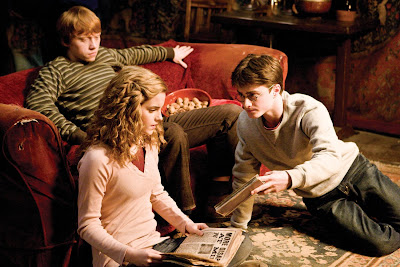
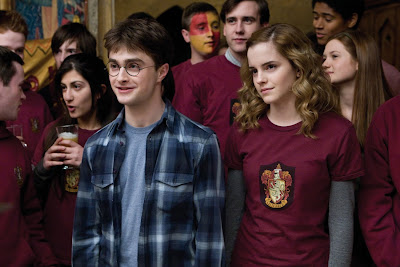
 Really, though, Harry Potter films work because the core trio — Hermione (Emma Watson), Ron Weasley (Rupert Grint) and Harry Potter — can carry a film all on their own. I truly hope these three young actors all find important roles in other films when the series ends in 2011 after a two-part Deathly Hollows, although I can’t imagine Grint as anything else but a Weasley. And I pray that Watson, now that her eighteenth birthday has passed, can escape the Internet perverts and skirt-invading paparazzi (one word Emma: "Panties") so she can concentrate on the acting talent she seems to have.
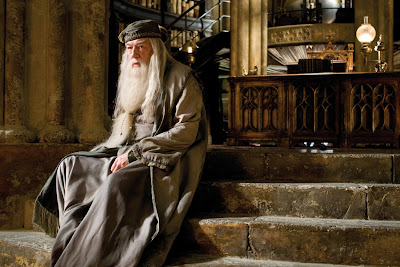
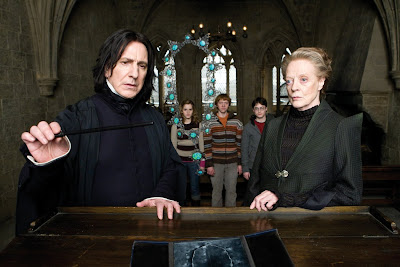
 I draw attention to the trio, but it helps that the they are surrounded by a talented ensemble including Gambon as wizard Gandalf the Gray … er, Dumbledore the Gay, and Snape, played by Alan Rickman, who is my own personal cult-figure superhero. Even the extras are interesting; you’ll know Elarica Gallagher when you see her. And then there’s Potter friend Luna Lovegood (Evanna Lynch), who’s so spaced out you have to wonder if she’s naturally this silly or just stoned. I could watch a whole movie of her brushing her teeth or mowing a lawn or something even more mundane.
 I must also comment on Tom Felton, the apparent long-lost son of Hulk Hogan who plays miserable little twerp Draco Malfoy. I can't remember the last time a character was so vile and venemous just by existing as a static peice of flesh in time and space. This poor kid; he'd even scowl at a wet snogging. As over-the-top as the character is — and how cruel for Felton, who perfectly delivers the same lines over and over again — I love Draco Malfoy. You gotta applaud him because his contempt for everything is refreshing.
Half-Blood Prince is not the best of the Harry Potter films, but it’s in a six-way tie with all the rest. Am I a coward for not picking a favorite? Maybe. But they’re all so fantastical and charming — and they’re all so consistently well made — that picking one favorite would betray all the other favorites.


 I’m certain of several things this summer, mainly these two: First, Transformers: Revenge of the Fallen is the worst film of the decade. And second, The Hurt Locker, which is effective counter-programming for transforming robots, is the best film of the summer.
Talking with Hurt Locker star, and early Oscar contender for best actor, Jeremy Renner, he agrees with me on all these points. Except maybe that Transformers one, to which he simply says, “Hey, to each his own. Nothing against Michael Bay.”
 Renner, whose claim to fame before this was playing cannibal serial killer Jeffrey Dahmer in Dahmer, plays a hotshot bomb disposal tech in Iraq in this gritty and excruciatingly intense Kathryn Bigelow (Point Break, Strange Days) war movie. I type “war movie” with some trepidation, though, because the movie is so much more: it’s an action movie, a psychological thriller and, ultimately, a character study about men drawn to the flame of what might be their own demise. Why do men go to war? This movie has that answer and many more.
Above all else, though, Renner just nails this nuanced, provocative performance of a man riding the razor’s edge that is bomb disposal in a warzone. In one scene he removes his bomb-proof protective gear so he can lay against a bomb, feel it’s mechanisms, channel its soul. “If I’m gonna die, I’m gonna die comfortably,” he says. No movie is half as intense as this one this year.
Renner, who said he is one of five actors being considered for the lead role in a Road Warrior reinvention (by Mad Max creator George Miller, no less), sat down and spoke with Volume/Pick-Up Flix before Hurt Locker opened in the Valley on July 10, and then expanded on July 17. Take mine and his word, and see this movie.
 Volume: Is America ready for movies about this war?
Jeremy Renner: I think America’s ready for this film. Without a doubt. If we box it into saying this is a war film, we’re boxing it in unfairly. At that point there have already been preconceived notions put upon it. It’s almost unfair to say that about films, like, “Oh look here, this is a real tearjerker movie.” That’s unfair to the film because it sends viewers into it with expectations; it’s going to limit the experience. So to call this just a war movie is unfair to the viewers, especially since it’s so much more. As far as being “ready” for this film, there’s a big audience for it. This film is an immersion. You go in to experience it, to feel it. That’s how well it’s made.
 Volume: War is, for the most part, a boys club. Do you think having a female director brought a fresh perspective to these types of actions scenes and also just the bonding soldiers go through?
JR: Kathryn has always proven to be a phenomenal, detail-oriented action director. She does film male subject matter for the most part …
Volume: There is nothing more male than Point Break.
JR: Exactly. But her gender doesn’t come into play here because her abilities are so focused and her energy is so exact in the details. I wonder if, in her mind, she wasn’t directing a war movie, the way I was thinking I wasn’t acting in a war movie. I can’t fathom how she works, because she’s so intricate. She’s a painter, a voyeur, an artist with a camera … she’s so many things, and I never thought, “Oh and she’s a woman, too.” She’s better than that.
 Volume: You’ve said the words voyeur and immersive. They must have been themes because the film was shot with dozens of cameras from dozens of different angles allowing an immersive, almost voyeuristic look at the material.
JR: The idea was to put you in those streets watching these guys diffuse bombs. There were days on set that I never saw a camera. Literally, days. We called them ninja cameras because they were on roofs, on balconies, under cars to get my feet walking past. She put her cameras in the most interesting places.
Volume: What kinds of things did real soldiers tell you before you went into this project?
JR: It was more me asking them questions, because they weren’t volunteering too much because they’ve never worked with actors. They learn how to make bombs and diffuse bombs for real, so dealing with some jackass actor was low on their list of priorities. I knew when I started asking good questions, though, because they told me stuff was top secret. One thing they stressed was that they would never run up to a car bomb that was on fire, which happens in the movie. Unless, of course, the president was in a nearby building or something. They’d send the bot down almost always. Some guys told me they relied on the bots so heavily that they rarely got out of their cars to take care of these roadside bombs. The soldiers I talked to did tell me about one guy who would walk up to IEDs, kick them and say things like, “Well, I guess I won,” and he’d pick the bomb up and drag it back.
 Volume: As far fetched as it was, though, I felt like your character’s renegade behavior was always justified, even when he ran up to bombs on fire. He was going against the grain on everything, even his own life.
JR: That’s a testament to how well this film was written. My character is clearly going against what he’s learned is safe, and going against all the instincts that pull people away from a bomb. He goes because he feels like he has to. He’s drawn to the danger out of necessity.
Volume: There are no villains in this movie. No nefarious bomb-making schemers. No ex-Marine Jihadists. Nothing like that. A lesser film would have been you hunting down and killing a bomb maker rather than you and your motivations in war — call it the Hollywood version.
JR: That makes the film more real. I mean, look at Hurt Locker: there isn’t a whole lot of plot, right? It’s just characters. A more Hollywood-type movie would have all the necessary plots and turns and developments. This film is free of all that. It moves on its own, to its own beat. It’s unrelenting.


 Public Enemies was much better when it was called Heat.
Both films are about relentlessly organized bank robbers and their methodical police counterparts. In both there are lovely women who complicate the bank robbers’ continued success. Both are long, drawn-out examinations on police and criminal procedure, and both are directed by Michael Mann, one of the most underrated directors in the business.
 Similarities aside, though, Mann’s new movie is hardly self-plagiarism — Public Enemies moves to its own rhythm — even if it is awful similar to 1995’s Heat, a movie that used atmosphere and mood to evoke a bank robber’s unceasing paranoia of capture, or just loneliness. Maybe Mann (Miami Vice, The Insider, Ali) was channeling John Dillinger while directing Heat, and now here he is telling Dillinger’s story in a film he couldn’t have foreseen 14 years ago. Or maybe he just repeated himself in a new time period with new actors. I can’t speculate further without infringing on a talented moviemaker’s catalog of crime capers.
 John Dillinger, “public enemy No. 1” as J. Edgar Hoover called him, was a criminal of principle who outshined his contemporaries and brought the entire federal government — or was it the Mafia? — crashing down on him. Here he’s played uncannily by Johnny Depp, who gives him more humanity than a criminal and murderer deserves, but it is that humanity that allow Mann’s movies their unique edge. Depp, and Mann's screenwriting (along with Ronan Bennett and Ann Biderman), never attempt to explain Dillinger, the man or the myth. They just present him, factually, unblinkingly.
 The film follows Dillinger’s rise in the 1930s from ex-con to the folk hero of crime lore, betrayed and gunned down on the sidewalk outside Chicago’s Biograph Theater, where his last moments alive were spent watching Clark Gable in Manhattan Melodrama. Yes, that’s the destination of Public Enemies, but it’s not the route.
In scenes of daring bank robberies, armed shoot-outs with Thompsons clucking away and high-speed chases in Model A Fords, Dillinger is shown as a loyal alpha male slugging men for their rude behavior, demanding love from his latest flame (Marion Cotillard) and forcing the mobs’ hand when he brings a reconstituted FBI and its crimestopping G-Men sweeping through the Midwest looking for trophies for Hoover’s mantle. Dillinger may have been a brute, but Depp plays him as a lover and a fighter, and a man deeply focused on beating the system. Of course, he’s wealthy beyond his imagination, but it’s not satisfying because money alone isn’t proof of victory.
 The film shares with us Dillinger’s biggest flaw: his friends. “Baby Face” Nelson, “Pretty Boy” Floyd and Capone associate Frank Nitti, these were the men that would eventually contribute to his ultimate demise, if not directly than from the heat brought in from Washington, D.C, where the FBI had a third of its operating budget designated for Dillinger’s capture or death. Also, Dillinger never stopped robbing people, which couldn’t have helped his wanted status. At one point in the film, Dillinger strolls into the FBI's Chicago field office, where they have a wing designated to his capture. He peruses through the cluster of desks admiring the work being done to track him down, and then even exchanges words with men who were supposed to know Dillinger better than their own wives. Apparently this really happened.

 Investigating Dillinger's crimes is FBI agent Melvin Purvis (Christian Bale), who was later erased from bureau history by a vendetta-prone Hoover, that weasel. Bale, whose single-note performance grows very thin here, never seems Depp’s equal and the FBI scenes droop because of it — although one interrogation sequence is superbly acted. For once I would have preferred that Mann stuck exclusively with the criminals rather than balancing a story across two polarized sides. One actor, Stephen Lang, plays an older FBI agent who has the best, and last line, in the movie in a jailhouse interview with Dillinger’s girlfriend. After Lang’s big scene ended I was picturing him in the Purvis role and admiring the potential improvements. For once, Bale was all wrong here.
 Exactly how accurate the events from the movie are — the prison break, the dust-up at the Little Bohemia Lodge, the set-up at the Biograph — I will let you discover with a Google search. Most of the scenes take place where they actually happened. A caution, though: The film is not the history of the facts, but a scenario of Dillinger’s potential emotions so don’t take too much stock in Mann’s revisionist Dillinger history.
 Overall, this is not one of Mann’s strongest films. It’s a well-made picture, with wonderful costumes and cars, and with all of Mann’s trademarks — an inconspicuous near-ambient score, terrifying weapon effects that seem too real to be just effects, and beautiful night photography — but it’s missing the forward momentum of some of his past works. And despite the big names in the cast list, Public Enemies drags itself to a point we all know is coming outside the Biograph. And when we get there, it's all very anti-climactic considering we still don't understand Dillinger, Purvis or what drove them to this intersection. The route, in this case, wasn’t worth the trip.


 World War II has been covered so extensively on film by so many gifted directors — and some hacks — that any true originality in the genre was mined long ago. Quentin Tarantino found a way around all the worn plots with this audacious strategy in his intentionally misspelled Inglourious Basterds: he wrote his own version of the war.
  That’s right, he just made stuff up. That should be sacrilege to history, especially since WWII is hallowed ground even 60-plus years after its end. But Tarantino gets away with it — he gets away with everything — because his film provides a catharsis that the war itself could not provide. In his version of events, the war ends after a rag-tag group of Jewish Americans stage a mass execution of German high command in a little French movie theater. Film buffs should have fun with that movie theater part. Only Tarantino, a noted film buff, could stage a gunfight in a projection booth. Only Tarantino could kill Hitler with in an inferno fueled by nitrate film stock. Only Tarantino would have a movie critic parachute into Nazi-occupied Europe to help end the war.
  It’s been widely reported that Tarantino wanted to merge a classic war movie with an epic Spaghetti Western. At one point the film was going to be called Once Upon a Time in Nazi-Occupied France, an allusion to the famous cowboy opera by Sergio Leone, an obvious influence here. Remarkably, almost inexplicably, QT accomplishes this Frankenstein-like assembly and then gives it the juice it needs to stomp through Kraut-occupied France in one of the most daring films of the year. Daring because you must adopt a new WWII history and also because impatient Tarantino fans will likely be challenged as the dialogue proves to be painstakingly, yet pleasantly, prosperous and the violence is shortlived, albeit quite gory when it does finally turn up in a head-smashing homerun derby.
 Not all of the dialogue is as flowery, though. Consider Aldo Raine (Brad Pitt), the leader of the Basterds, a group of American troopers sent into France to scalp Nazis first and ask questions … well, never. Raine talks like he learned English from a drill instructor: “You probably heard we ain’t in the prisoner-takin’ business. We in the killin’ Nazi business. And cousin, business is a-boomin’.” Each word is nearly grunted, but he grunts to an unheard rhythm, and Pitt grins from behind the character, a stone-cold killer reduced to lovable miscreant if only because history has allowed us to hate Nazis as much as him.
  German actor Christopher Waltz should be a shoe-in for an acting nomination this year for his role as Col. Hans Landa, the officer from the first scene and many others like it. His dialogue is prepared so meticulously, with reverence to the needs of the movie and of the character, yet he explodes from the pressed Nazi uniform. He’s one of the most demented characters created this year, and somehow also one of the most electric and captivating.


